Author: Shift Team

  • The Full Life Cycle of Maritime Batteries

    Environmental impact offset 1.4 months

    Batteries are becoming a relevant and cost effective means of reducing emissions of both greenhouse gases and NOx from the maritime industry. However, not much has been said about the environmental impact of the material extraction, production, and transportation of the batteries. With COP23 talks in progress this presents a great opportunity to explore the full emissions picture of batteries in hybrid and electric ships.

    Recently the Maritime Battery Forum in cooperation with Grenland Energy, ABB, and DNV GL for the Norwegian NOx-fund published a report on the life cycle assessment of batteries used in ships. The study was structured as a cost-benefit analysis, where the environmental costs of creating the battery system (the energy storage and power conversion) was compared to the emissions savings of using the battery, and an environmental payback time was calculated.

    For a typical electric ferry, the environmental impact of producing the batteries will be offset by emission reduction in the ship within 1.4 months. If batteries are used in a typical offshore supply vessel and used as a partial replacement for a main engine, it takes 1.5 months.

    The environmental repayment period is remarkably short. The result clearly shows that marine electrification is environmentally friendly, at the same time it has been shown to also be a profitable solution for ship owners. Furthermore, a DNV GL study, which modelled the entire Norwegian fleet based on AIS data, showed that even if all known energy efficiency techniques are employed in all ship types of the entire domestic fleet, it will not be possible to reduce emissions from domestic shipping by the 40% target. Alternative propulsion such as the use of fully electric vessels is necessary to achieve emission reduction goals.

    You can read the full study, published in both English and Norwegian here.

  • PBES at COP23

    PBES bringing the electric revolution to the seas at COP23

    PBES will be having its voice heard at COP23 next week in Bonn, Germany. PBES CEO Brent Perry will be speaking at three sessions during the weeklong event. Our focus in marine electric infrastructure and technology, will provide insight as to how big industry will plug into a cleaner, cheaper and more climate friendly system. The maritime industry has long been the elephant in the room when global fossil fuel emissions are evaluated. How do we reconcile the enormous cost to our world of continued unabated use of fossil fuels to power our fleet of commercial vessels? Until recently, the commercial fleet has been unrestricted due to their importance to trade.


    This year’s UN Climate Summit will be held in Bonn, Germany 6 – 17 November. PBES will be part of several events including:

    Ambition 1.50 C Global Shipping’s Action Plan – November 13, 2017

    The Shipping Industry has committed itself to take a “Fair Share” on emission reductions. The conference will create a Global Shipping´s Action Plan that helps to achieve these targets.

    Brent will be taking part in the technology panel (Inspiration focus), that will be kicking off proceedings at 1030-1100.

    Event details: https://www.shippingambition1o5c.com/about.html


    Bellona COP23 Event – Organized by: The Bellona Foundation and Nordic Council

    Taking the Electric Revolution to the Seas

    Nordic countries – Norway in particular- have during the last three years experienced a surge in new builds and orders for ships powered by batteries. This session will explain how policy frameworks and green procurement practices have fostered the establishment of maritime battery production and a massive electrification of ferries. Speakers include representatives from Wartsila, tour operator The Fjords, Yara International, battery manufacturer PBES and The Bellona Foundation.

    Wednesday 15 November, 12:30 PM – 13:25 PM, Nordic Pavilion, Bonn Zone

    Policy coherence in electric infrastructure on land and at sea.

    Ensuring compatible technologies and setting common standards are key to kick starting Europe’s electric revolution. But the market is changing fast. This calls for a fine balance between standardization and leaving room for innovation. This event will highlight infrastructure needs, synergies between land and sea transport infrastructure, and policy coherence. Speakers include representatives from ferry company Color Line, battery manufacturer PBES, Wärtsilä, Nordic Council and Bellona Europa.

    Thursday 16 November, 13:30 PM – 15:00 PM, Nordic pavilion, Bonn Zone

    Full program details: https://network.bellona.org/content/uploads/sites/3/2017/10/Bellona-COP-23-Event-Program.pdf

  • Industrial Evolution – Zero Fuel Passenger Ships a Reality Today

    PBES keynote presentation at Interferry 2017

    The maritime industry has long been the elephant in the room when global fossil fuel emissions are evaluated. How do we reconcile the enormous cost to our world of continued unabated use of fossil fuels to power our fleet of commercial vessels? These vessels are vital to our economy, transporting people and goods across the oceans to reach markets. Until recently, the commercial fleet has been unrestricted due to their importance to trade.

    Soren Danig, VP Business Solutions in Denmark, recently delivered a keynote at the annual Interferry conference in Split, Croatia about the industrial evolution of zero emission ships of today.

    Bringing the electric revolution to the seas has reduced emissions but also proven to be financially profitable to ship owners. The use of energy storage to provide power for emission free operation is here today. Using this industrial evolution of propulsion, the marine industry is able to lower operational costs and provide meaningful return on investment all while doing its part in the fight against climate change.

    Now more then ever it is apparent that the marine industry must act on climate change.  Recent global climate events underscore the need to shift away from traditional fossil fuel as a power source. New national and international regulations are forcing operators, owners and shipbuilders to look at alternate sources of propulsion energy, the most effective of which is energy storage in the form of lithium batteries used to hybridize and fully electrify ships.

    Watch the full presentation below, and visit the Interferry conference website to watch all the video presentations here.

  • Elektra Hybrid Electric Ferry

    Elektra Hybrid Electric Ferry

    Basic info

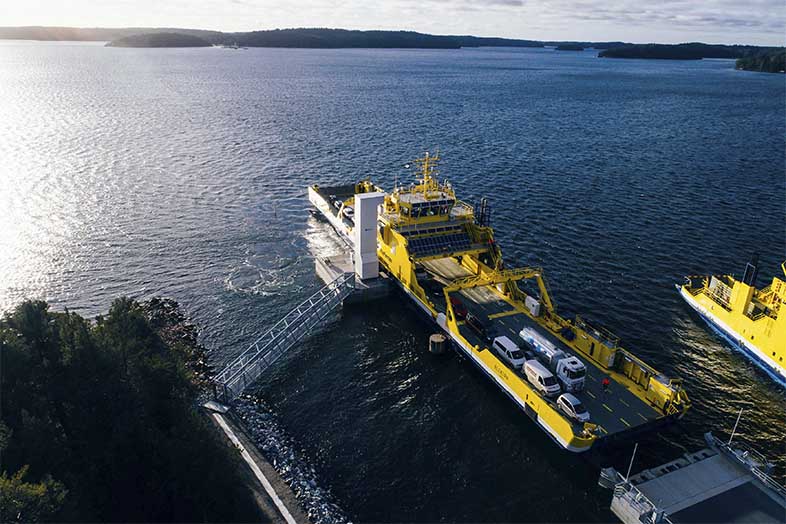
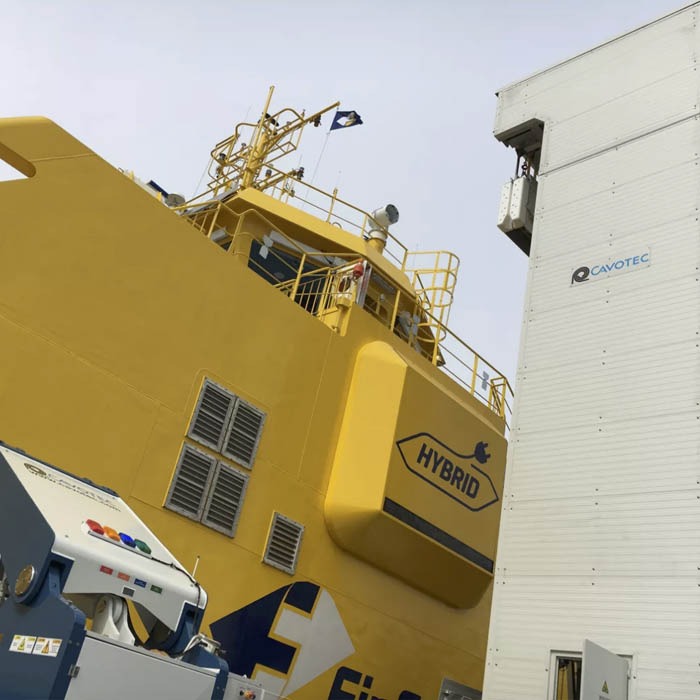
    This double-ended ferry has paved the way for a new type of ship, the hybrid/electric ro-ro. Finnish state-owned ferry operator FinFerries is only the second operator in the world to build such a vessel but remains the first of its kind to recharge its batteries at each end directly from the domestic power grid; Norwegian Ampere was the first however it draws its power from banks of batteries at each terminal. In June 2017, the Elektra began regular operation between Nauvo and Parainen in the Turku archipelago. Designed to be a 24/7 workhorse, it travels this route every 15 minutes during peak hours and once an over overnight.

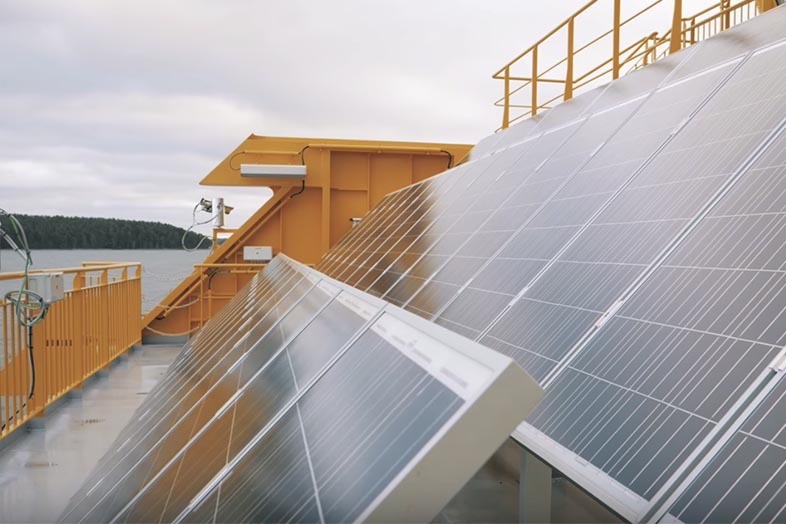
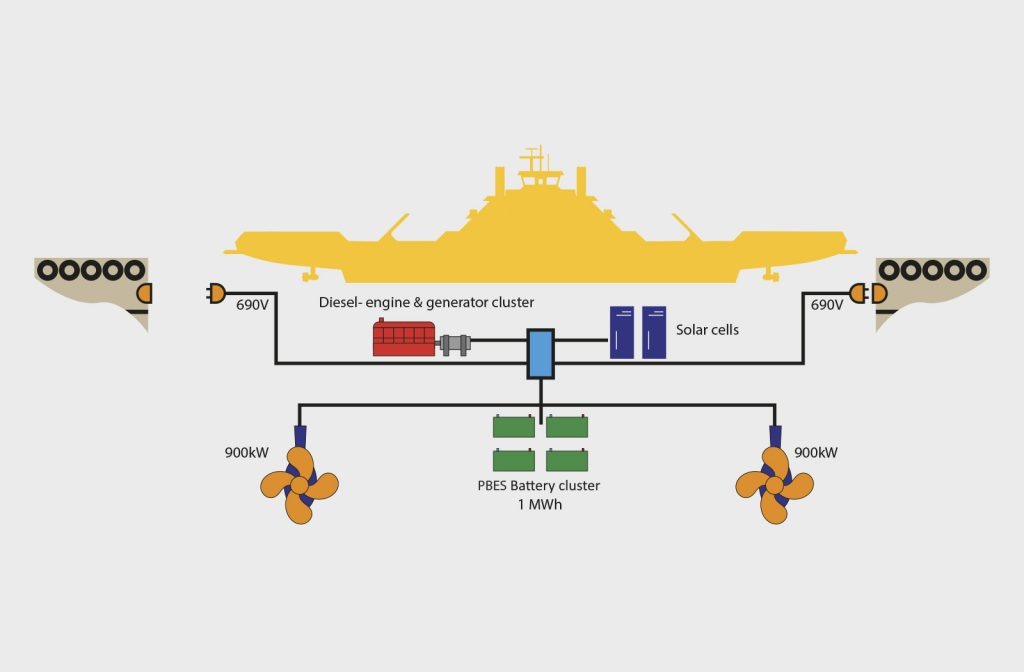
    The System: The two lithium-ion battery packs each have a capacity of 530 kWh (1MWh total storage), one in the forward and one in the aft machinery space.  Both banks are charged simultaneously but each is dedicated to one of the thrusters. Each trip uses about 15% of the batteries’ capacity, which must be replaced during each brief port call. This energy storage system was design for a 10-year lifetime. The engine room is equipped with a pair of 900kW, Z-drive, azimuthing thrusters from Rolls-Royce, and three diesel generators –divided between two engine rooms, each deliver 420 kWh when needed. Because of the harsh winter conditions in Finland, the ferry can use diesel engines to support the onboard batteries, which serve as an extra boost travelling through ice. This gives three power modes: pure battery; diesel-battery hybrid and diesel-electric. And to add to her eco-friendly profile, just below the bridge, rows of photovoltaic cells from Activesol of Poland, provide enough power during summer months to run the air conditioning and other hotel loads.

    Charging in 5 Minutes: The fast-turnaround pattern for the ferry means that it only leaves a minimal, five minutes at the quay for recharging. The ferry docks with a Cavotec vacuum auto-mooring system which holds the vessel in the right position. The Moor Masterunits signal to the APS when the ship is securely moored, before a laser sensor guides the connector that opens from the side of the vessel where it connects to the ship’s battery to begin charging. The value of energy storage compared with the existing conventional ship on the route, Sterna, Elektra carries 40% more vehicles but with 60% less emissions and the electricity cost is trivial: just €5 (US$6) of electricity per crossing.

  • Aurora Electric Ferry

    Aurora Electric Ferry

    Basic Info

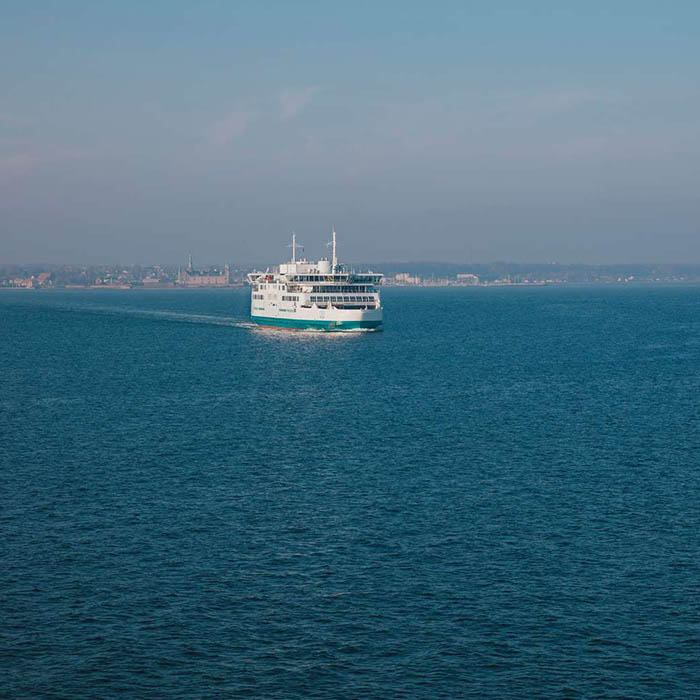
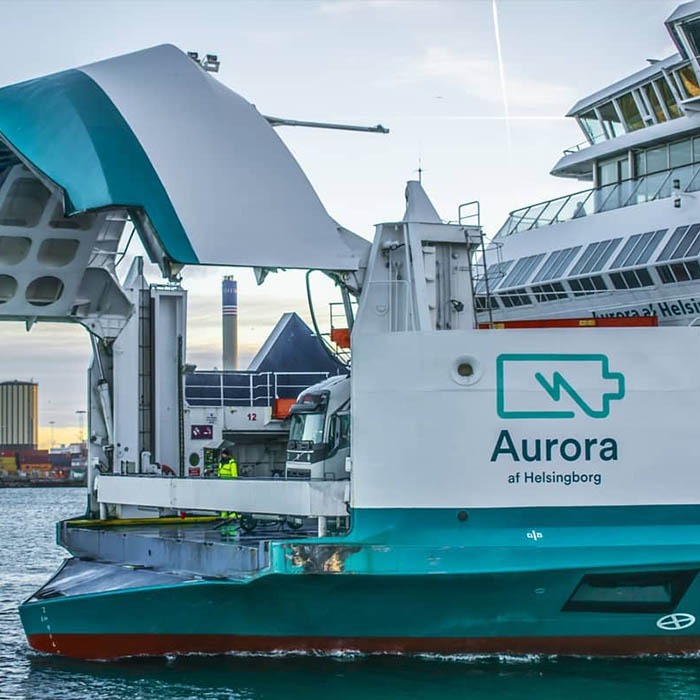
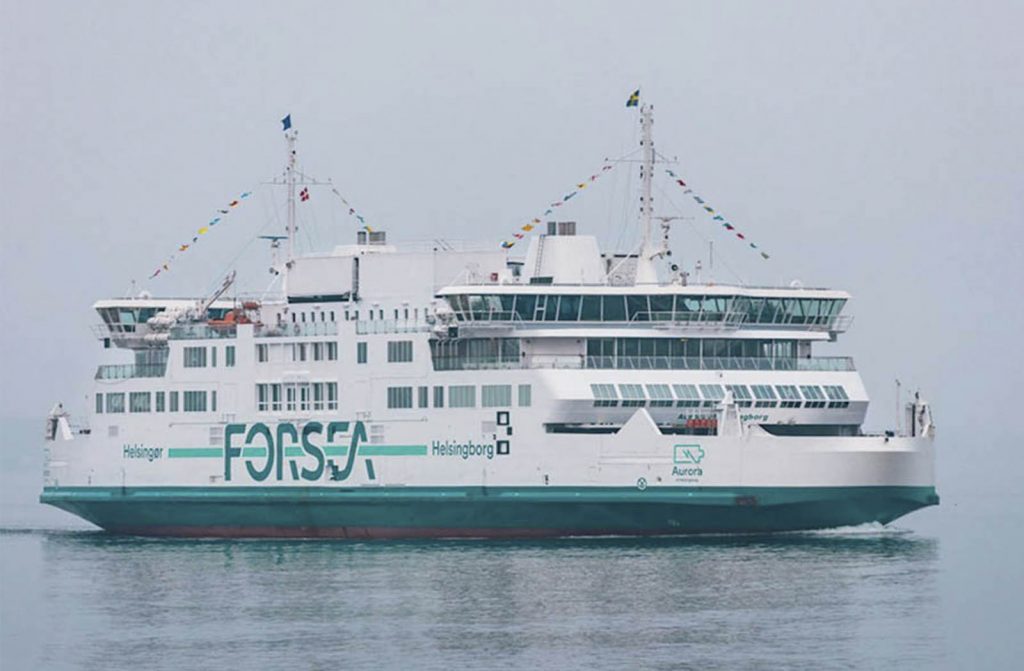
    The Aurora is a fully electric passenger ferry. It measures 238 meters (780 ft) and weighs 8,414 tonnes. It operates on a 4 km ferry route between Helsingborg (Sweden) and Helsingör (Denmark). The massive ship carries 7.4 million passengers and 1.9 million vehicles annually.

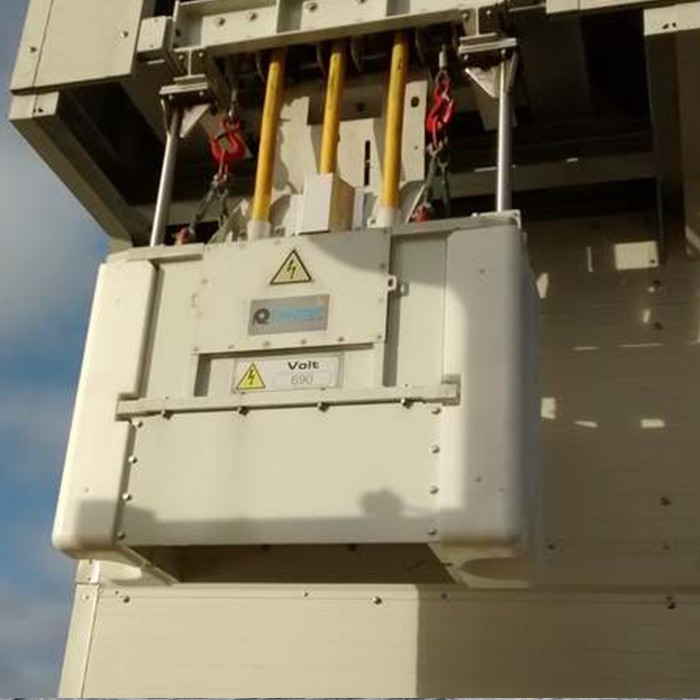
    System Specifications: The system is comprised of 640 6.5 kWh batteries installed on top of the ferry in containers. Cables run from the containers to connecting points at each end of the ship.

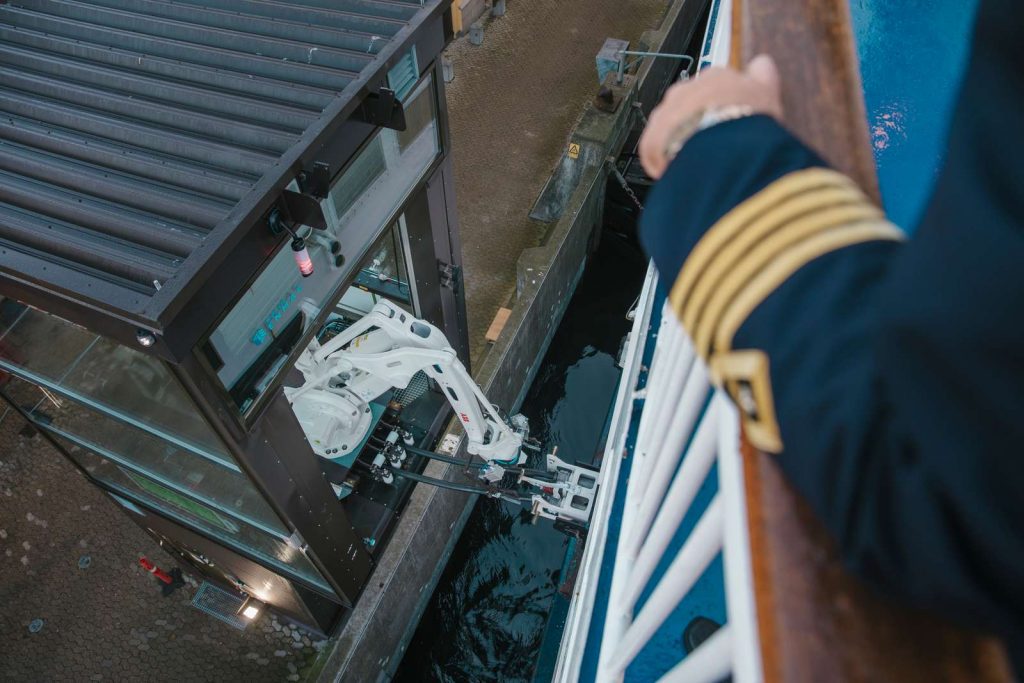
    Charging: All pre-docking procedures are based on 3D laser scanning and wireless communication between ship and shore. During the last 400 mm of the ferry’s approach the robot will reach out and pull the shore cable from the ship. The cable reel releases the cable and the robot moves the connectors to the corresponding connectors below the robot. After the connection is made, the robot moves back to the home position and the roll-up doors closes. The robot will reside inside its own building when not in use.

    Zero Emissions

    ForSea Ferries have chosen to charge their batteries with “green electricity”, from non-fossil fuel sources such as wind, water and solar energy. This means that there are no emissions from the two battery-operated vessels.

  • PBES Announces DNV GL Type Approval

    PBES energy storage system meets safety and quality standards for use in commercial marine applications

    PBES and DNV GL today announced DNV GL Type Approval of the PBES energy storage system for use in commercial marine, offshore oil & gas and renewable energy applications.

    DNV GL is the world’s leading classification society and technical advisor to the global marine, oil & gas and industry renewable energy sectors. The type approval of the PBES system opens global marine markets by providing PBES’ customers with security in knowledge that their vessel will meet class standards.

    “PBES celebrates the certification of our systems to this highest standard,” said Brent Perry, PBES Chief Executive Officer.

    “Global reach and dominant position in classification across multiple markets make DNV GL the most important validation PBES can receive.”

    “We would like to congratulate PBES Norway on this achievement,” said Sverre Eriksen, DNV GL – Maritime. “It was a great pleasure to work with PBES during the approval process and going forward their customers can be confident that the PEBS storage system has been tested to meet strict safety and reliability standards.”

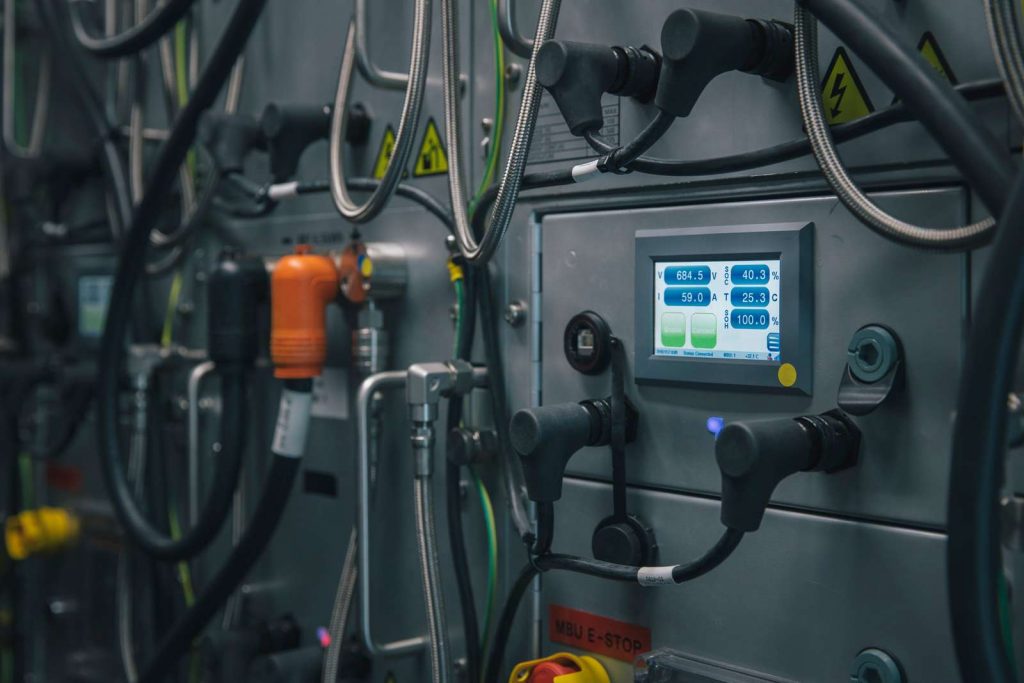
    The PBES energy storage system has been designed to the highest standards of performance, safety and sustainability. Featuring PBES’ patented CellCool cell level liquid cooling, ThermalStop anti-propagation barrier, E-Vent gas venting system and CellSwap battery re-coring, it is designed to seamlessly integrate with all types of power generation in a variety of commercial and industrial applications.


    About DNV GL – Maritime

    DNV GL is the world’s leading classification society and a recognized advisor for the maritime industry. It enhances safety, quality, energy efficiency and environmental performance of the global shipping industry – across all vessel types and offshore structures. DNV GL invests heavily in research and development to find solutions, together with the industry, that address strategic, operational or regulatory challenges.

    www.dnvgl.com/maritime

  • Norway to study shift from oil to tackle climate risks

    Norway will study ways to make its economy greener and reduce dependence on oil and gas reserves that are likely to lose value amid efforts to slow climate change, Environment Minister Vidar Helgesen said on Thursday.

    A government commission of experts, to be appointed in coming days, will examine the nation’s green competitiveness and ways to insulate western Europe’s biggest oil and gas exporter from financial risks linked to climate change.

    “Given the energy and transport revolutions, fossil energy resources will be of less value over time,” Helgesen told Reuters.

    “The energy transition to renewables is going faster than anyone thought. And almost any scenario is being out-competed by reality,” he said, adding that the commission would report back in about a year’s time.

    Oslo says it has made big strides, for example in battery technology for shipping, including coastal ferries. But it needs to look for new businesses based on emerging technologies, from fisheries to digitalization.

    Norway is far from its goals under the 2015 Paris climate agreement to cut its greenhouse gas emissions by 40 percent below 1990 levels by 2030. Emissions were 3.3 percent above 1990 levels in 2016.

    Helgesen said that Norway was “fairly well” placed to handle economic and financial risks compared to other countries because of a $1 trillion sovereign wealth fund, the world’s biggest, built on revenues from oil and gas.

    Link to original article on Reuters here

  • PBES Norway and Norwegian Solar AS announce Partnership Agreement on Containerized Storage for Solar Projects

    Norwegian Solar offers PBES energy storage to support renewable energy generation

    PBES and Norwegian Solar AS today announced a partnership agreement to provide PBES energy storage to support solar power generation in global markets. PBES will supply containerized storage solutions for Norwegian Solar’s systems being deployed in the USA and Saudi Arabia. This partnership underscores the rapid development of solar energy around the world, and the need for energy storage providers to create innovative flexible solutions to ensure maximum feasibility for renewables projects.

    PBES’ storage solutions will be used to help the solar projects cope with peaks in demand by supporting higher output loads, as well as balancing out the supply by storing energy generated during the day at night. With the containerised design enabling rapid installation, this will contribute significantly to the success of solar projects around the globe.

    Norwegian Solar is a company with similar drive and ambition to PBES,” said Brent Perry, PBES Chief Executive Officer. “Their attention to quality customer service and ability to move quickly provide PBES with confidence that they are an ideal partner to bring our energy storage products to solar customers in the USA and Saudi Arabia.”

    “We are pleased to announce the agreement with PBES,” stated Nils-Ivar Dyngeland, CEO and Founder, Norwegian Solar AS. “Much of the future of energy generation will be based on turn-key integrated solar and energy storage. After careful evaluation, the advantages of PBES’ innovations such as liquid cooling and CellSwap became clear. The company’s solution driven values fit well with our own.”

    The PBES energy storage system has been designed to the highest standards of performance, safety and sustainability. It is designed to seamlessly integrate with all types of power generation in a variety of applications.

  • Putting the Safety into Battery Driven Propulsion

    Interview with PBES’s Grant Brown in the September issue of The Navel Architect. Access the digital issues here

    Whether for hybrid or fully-powered, advances made in lithium-ion batteries have allowed the technology to quickly establish itself as a viable solution for marine propulsion. Since the launch of the first diesel-electric hybrid ferry, the 43m ro-ro MV Hallaig, in December 2012 the scale and ambition of such projects has moved on leaps and bounds with new projects, both retrofits and newbuildings, announced almost monthly.

    Ferries, offshore and smaller vessels remain the focus for battery-powered innovation, spurred on in no small measure by the impetus of tightening emission-control regulations. However, Norwegian travel company Hurtigruten’s announcement in September 2016 that its forthcoming polar expeditionary ships Roald Amundsen and Fridtjof Nansen (due for delivery in 2018 and 2019 respectively) would deploy sustainable hybrid technology is seen by many as a watershed moment. And while its seems unlikely that we will see battery-powered vessels engaged in long-haul transportation any time soon, it no longer seems beyond the realms of possibility.

    One company with a vested interest in the technology’s continued progress is Canadian manufacturers, Plan B Energy Storage (PBES). Founded in early 2015 by Brent Perry, the former CEO and founder of rival battery suppliers Corvus Energy, PBES has quickly established itself with an outspoken commitment to marine energy storage ‘done right’, placing a strong emphasis on quality.

    Grant Brown, PBES’s VP for Brand and Marketing (and, like Perry, also one of the co-founders of Corvus) explains:

    “Due to our experience with other products and projects in the past, when we designed this battery we really looked at how we could make it as safe as possible. The last thing anybody wants is a fire on board a ship. Lithium fires are very unpredictable and difficult to extinguish when they start propagating.”

    In order to achieve this, PBES incorporated a number of unique safety features into its batteries. The most important of these, according to Brown, is a patented liquid cooling system they call CellCool.

    “CellCool liquid cooling does two things: it provides a safety feature in that it prevents our battery going into thermal runaway [when the heat generated within the cell causes a reaction between the cathode material and electrolyte], because the cooling system can extract more heat than the cells can produce. We’re the only battery in the world that can actually prevent thermal runaway from occurring, not just spreading from cell to cell.”

    While other battery systems rely on air cooling, the PBES method is similar to that found in the engine block of a car. Water is circulated through and around the components before exiting. Because the water is low pressure (around 4psi) it doesn’t put strain on the internal seals and components of the cell.

    The cooling system is further enhanced by the use of cooling elements within the holders of the battery cells. Unlike many of their competitors, PBES has elected to use aluminium housing for their cells, rather than the more typical (and cheaper) glued-in plastic casing which can’t be serviced and requires the replacement of the entire battery. It also facilitates a unique CellSwap system which makes it possible to replace the cell core — each cell is roughly the size of a magazine and slots into the 10mm thick aluminium housing — without any interruption to the vessel’s service, not to mention cutting down on electronic recycling.

    Safety features are integral to every aspect of the PBES battery design, says Brown. The battery’s contactor is built-in and opens up in such a way in that there is no voltage or danger of electrocution while it is inactive. Another is the patented E-Vent system, which channels fumes away through a chimney that leads outside in the event of thermal runaway. Brown says:

    “The reason for this is that when lithium cells start to combust they create a combination of hydrogen gases that is very flammable. The smoke in a lithium fire is actually hydrogen gas, you can’t have that in the engine room of a vessel where the firefighters wouldn’t even be able to re-enter the room because of the potential for an explosion.”

    PBES – which has already opened regional plants in Norway, Denmark and China – produces two battery solutions: the PBES Power 65, a 6.5kWh (75 ah cells) module optimised for high performance across a five-year lifespan, and the PBES Energy 97, a 9.7 KW/h (112 ah cells) battery comprised of the same parts but a higher energy density cell. Brown explains:

    “It’s a 30% decrease in size, weight and ultimately cost. With cell swap it means the owner can start with one type of cell and potentially change them if the ferry changes its route and has different energy needs.”


    To read the full article visit https://www.rina.org.uk/

  • PBES Appoints Commercial Marine and Energy Professional to Develop Mediterranean Markets

    Norwegian energy storage company further strengthens business development resources

    Plan B Energy Storage (PBES) announced that Sven Thy Christensen has joined the firm to develop marine and power markets in the Mediterranean region. Mr. Christensen brings decades of experience of green solutions for ship efficiency, emissions reduction, and power generation including diesel and gas generation, wind and solar energy.

    Mr. Christensen comes from Odense Maritime Technology, where he held the position as Sales & Business Development Director. Prior to this he worked for MAN Diesel & Turbo in Spain. Here he spent four years as Managing Director Deputy, representing the company at Spanish shipyard group Astilleros Españoles, and then ten years as CEO for Spain for all group companies, simultaneously responsible for business development in Latin America.

    Sven is a mechanical engineer with a graduate diploma in business administration, both from University of Copenhagen. He holds the honorary title as Copenhagen Goodwill Ambassador, is a member of the Danish Association of Engineers (IDA), and of the Spanish Society of Naval Architects and Ocean Engineers (AINE).

    “The spirit and focus of the company is remarkable,” said Sven Thy. “PBES technology provides outstanding safety and performance and fulfils long awaited storage solutions in the maritime, the energy and industrial sectors. I look forward to the challenge of placing PBES product in power generation applications around the Mediterranean.”

    “Sven’s experience with marine and land based power generation gives him direct experience and clear perspective,” commented Brent Perry, CEO, PBES. “He has achieved success in the most demanding of industries. He is a natural fit for this team.”

    PBES’ high performance lithium batteries are known as the safest in the world. Thermal-StopTM CellCoolTM and CellSwapTM systems make PBES batteries safer, longer lasting and better value than any other product available today.