Category: Cruise & Ferry

  • A battery-driven ferry that promises to clean up the market in more ways than one.

    A battery-driven ferry that promises to clean up the market in more ways than one.

    Excerpts from Stevie Knights articles published in Maritime Journal.  Links to original article here.

    New tech comes with a price, but there’s a lot resting on it – all the more so when it concerns a commercial, battery-driven ro-ro that promises to clean up the market in more ways than one.

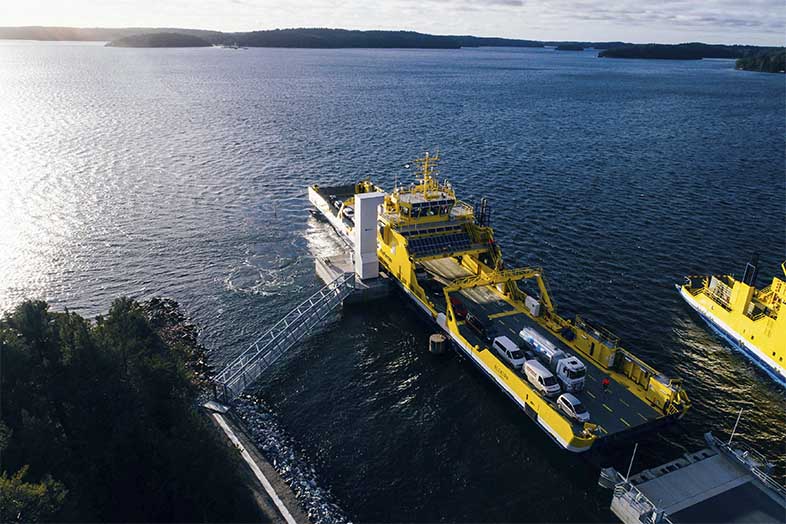
    The power for Finland’s new battery ro-ro, Elektra is the 1MW PBES energy storage system, split into two banks, powering a pair of 900kW, Z-drive, azimuthing thrusters from Rolls-Royce: “These mean Elektra can actually move sideways, so it’s easy to manoeuvre,” said Mats Rosin, FinFerries’ CEO. The 97.92m Elektra needs to be a 24/7 workhorse as it’s expected to run four times an hour during peak hours and once an hour overnight. The 1.6km ‘gateway’ between Parainen and Nauvo has between 600,000 and 800,000 vehicles crossing a year including heavy goods trucks but a sharp summer spike means over 100,000 vehicles in July alone.

    There are recharging points at both the Parainen and Nauvo turnarounds; a Cavotec vacuum mooring system and recharging tower combo holds Elektra in place while allowing a plug to descend from above to mate with Elektra. The 20kV of power is delivered to a transformer some 150m from the charging tower which reduces it to 690V AC for transfer to the ship. The grid had been recently strengthened nearby, and so it was able to deliver the necessary charge.

    The 160 6.5kWh PBES Power batteries have been lined up for an installed total of 1,040kWh at 1,000V on the DC bus. Elektra uses roughly 125kWh from shore every 30 minutes.  However, the batteries could absorb power at quite a rate as the banks can comfortably charge at 3C, so they could, theoretically, fully charge from empty in 20 minutes. This is partly because the batteries are liquid cooled; after all, putting a bolt of energy through even capacious batteries can shorten the cell’s lifetime.

    https://www.youtube.com/watch?v=RB6rKP34Mtk

    It’s not seawater from outside but rather a closed loop of tightly temperature-controlled tap water (the region’s domestic supply being incredibly pure and uncontaminated).

    More, as depth of discharge also affects the cells’ lifetime, these too are being rigorously bracketed, with the top rising to no more than 80% and the bottom sinking no lower than 60% of the total capacity. Of course, Siemens’ will be watching, monitoring all this and more via a Cloud link.

    It’s nice that while Siemens ties battery information together on the touchscreens mounted in both the bridge and power control room, PBES has also installed easy-to-read data displays on each case, showing heat, loading rate, state of charge, state of health and so on, not just for that battery alone but for the whole bank.

    The new ro-ro also is fairly comfortable to operate, just as well since the shifts are 12 hours long, with just a captain, engineer and deckhand onboard. It’s quiet: even in the so-called ‘engine room’, there’s normally no need to raise your voice, the only residual vibration comes from the 900kW Rolls-Royce Z-drive thrusters although there are three auxiliary gensets for redundant power for charging failures or ice conditions.

    Despite the investment, pegged at around 20mEuro for the total project including infrastructure, Elektra’s very cheap to run – based on Ampere’s figures it probably costs no more than a handful of Euros for each recharge. The most important thing about ‘Elektra’, Finland’s new, double-ended ferry is that it paves the way for a new breed of vessel.

  • PBES Batteries Power Finland’s First New-build Battery Electric Ferry

    Winter in Finland won’t stop Elektra from meeting her mission

    PBES is proud to announce the contract, supply, and installation of the 1MWh battery on Elektra. Launched in June of 2017, the vessel celebrates 6 months of service and is Finland’s first purpose built battery electric ferry.

    “PBES energy storage provides Elektra with clean, quiet, fossil free power,” said Grant Brown, Vice President Marketing at PBES. “Due to patented CellCoolTM technology the battery may be recharged in 5 minutes and at end of life it may be refurbished and upgraded to reduce electronic waste using PBES CellSwapTM.”

    Elektra has an overall length of 98m, beam of 15m and draft of 3.55m, with five lanes to accommodate up to 90 cars. She travels her 1.6 km route across the Finnish archipelago year round. Due to heavy ice conditions in the winter months, she carries auxiliary power generation equipment to augment the battery when needed.

    In 2017 PBES installed more than 15MWh of energy storage to marine markets around the world, making it the leader in delivered product in the industry. The PBES energy storage system has been engineered to the highest standards of performance and safety and is designed to seamlessly integrate with the electrical infrastructure on the vessel.


  • Industrial Evolution – Zero Fuel Passenger Ships a Reality Today

    PBES keynote presentation at Interferry 2017

    The maritime industry has long been the elephant in the room when global fossil fuel emissions are evaluated. How do we reconcile the enormous cost to our world of continued unabated use of fossil fuels to power our fleet of commercial vessels? These vessels are vital to our economy, transporting people and goods across the oceans to reach markets. Until recently, the commercial fleet has been unrestricted due to their importance to trade.

    Soren Danig, VP Business Solutions in Denmark, recently delivered a keynote at the annual Interferry conference in Split, Croatia about the industrial evolution of zero emission ships of today.

    Bringing the electric revolution to the seas has reduced emissions but also proven to be financially profitable to ship owners. The use of energy storage to provide power for emission free operation is here today. Using this industrial evolution of propulsion, the marine industry is able to lower operational costs and provide meaningful return on investment all while doing its part in the fight against climate change.

    Now more then ever it is apparent that the marine industry must act on climate change.  Recent global climate events underscore the need to shift away from traditional fossil fuel as a power source. New national and international regulations are forcing operators, owners and shipbuilders to look at alternate sources of propulsion energy, the most effective of which is energy storage in the form of lithium batteries used to hybridize and fully electrify ships.

    Watch the full presentation below, and visit the Interferry conference website to watch all the video presentations here.

  • The Largest Electric Vessels Ever Produced. Running on PBES Lithium Batteries.

    Two massive ferries are about to become the biggest all-electric ships in the world
    Article published by Fred Lambert, Published by Electrek on  Aug. 24th 2017.  Read the full article on electrek.com


    Over the last year, ABB has been converting two of Sweden’s HH Ferries Group’s massive ferries from diesel engines to being completely battery-powered.

    Now the ships are reportedly close to launching, which would likely make them the biggest all-electric ships in the world.

    As we have often discussed in the past, all modes of transportation are gradually being converted to electric propulsion and that includes maritime transport.

    Ferries are a perfect place to start since they often travel only short distances and stay for relatively long periods of time at the same ports, where they can be charged.

    The HH Ferries Group’s two ferries, the Tycho Brahe and the Aurora, operate a 4-km (2.5 miles) ferry route between Helsingborg (Sweden) and Helsingör (Denmark). Therefore, the route that they are converting to all-electric transport is not exactly impressive, but the actual ships themselves are something.

    They are 238 meters long (780 ft) and weight 8,414 tonnes. They carry 7.4 million passengers and 1.9 million vehicles annually.

    Those are incredibly large machines to power with electricity, but it’s worth it economically for the savings on diesel and environmentally to slash local emissions. They are already similar ferry routes going electric, but nothing of this magnitude in term of size.

    ABB already started installing the more than 4 MWh of battery packs inside each ship:

    “640 batteries of 6.5 kWh are installed on top of each ferry along with two deckhouses for transformers, converters and cooling of the batteries. Cables run from the deckhouses to connecting points at each end of the ship, so that the batteries can be quick-charged – to provide the power of 70 electric cars.”

    The Tycho Brahe is reportedly ready and it was supposed to start operation last month, according to HH Ferries Group’ website, but they had to postpone the launch because the charging systems at the docks are not ready.

    ABB has been installing giant robotic arms at the docks to operate the charger.

    Continue reading the full article at Electrek

  • PBES Selected for new HH Ferries Contract

    PBES Lithium Energy Storage Selected for new HH Ferries Contract

    Norwegian/Canadian PBES awarded supply contract for worlds largest battery-­‐powered ferries

    Trondheim, Norway – October 4, 2016 – Plan B Energy Storage (PBES) today announced the energy storage supply contract for the two largest battery-­‐powered ferries in the world. Each of the two Scandlines Helsingborg-­‐Helsingör ferries will have 4.16 MWh batteries to provide power for primary propulsion.

    The fully electric ferries will carry their part of more than 7.4 million passengers and 1.9 million vehicles annually with zero emissions. INEA, the EU’s executive agency for innovation and network, supports the SEK 300 million project with SEK 120 million.

    aurora-af-helsingborg-1000x562

    The energy storage system, designed by PBES with a proprietary liquid cooling system that provides a higher level of safety to marine customers, is part of ABB´s modernization package, which also includes energy storage control system and Onboard DC Grid technology. The thermal management system constantly maintains optimal internal temperatures to maximize lifespan of the battery.


    eu


    (more…)

  • A New Breed of Superyacht is Emerging

    The Hybrid Superyacht – the ultimate in freedom & efficiency

    Unlike conventional vessels, the hybrid superyacht allows a choice between traditional power generation or a clean onboard energy source. Efficiency is given a high premium, and energy storage maximizes efficiency while increasing performance, safety and comfort.

    Battery only operation of the yacht provides the ultimate beach club and dinner cruise experience; no noise, vibration or generator fumes. With energy storage, the yacht can stay independent of shore power longer to use undersized shore power facilities. The vessel can now stay in marinas, ports and anchorages previously impossible due to strict “no-generator” regulations.

    (more…)

  • Ship of the Year

    “As the founder of Corvus Energy in 2009, I brought the marine industry a world first – a purpose designed energy storage solution to meet the needs of the marine customer. In the years following my departure it is apparent the industry is learning through failure, yet failure is the best teacher. Corvus’ failures taught us a lot and we treat it as a learning experience. As we move forward with PBES, we start with a clean slate of technology and grow the industry with a clear focus on safety, performance and value for our customers.” Brent Perry, CEO, PBES 


    Translated version of the Norwegian TU article “Vision of the Fjords” published September 5, 2016, by Tore Stensvold – see original here.

    The unique tourist vessel “Vision of the Fjords” is an innovative ship with hybrid drive. Forty meters long, Vision of the Fjords runs between Flam and Gudvangen in Sogn og Fjordane. During transit stages yesterday the Carbon fiber catamaran ran with a diesel generator and as soon as it entered the UNESCO’s World Heritage site area, switched to battery power..

    Favourite for an award!

    Now the ship favourite for the coveted title Ship of the Year – Ship of the Year 2016 award ceremony will be in Hamburg on Wednesday 6 September.

    seasight_foto_emil-rasmussen-br-aa-1000x481Even though engineers and visionaries get excited about the technology, it is the design that has people taking notice.

    – It is a paradox. We are known for building fast catamarans. However, we have never seen so much attention as after we launched Seasight just over a year ago, says CEO Tor Øyvind Aa.

    Normally we build catamarans in carbon fiber that go 25-35 knots. Seasight-catamaran is built 8 knots and maximum 19.5 in transit. In tourist pacing mode of 8 knots, the battery pack from the Norwegian ZEM and energy management system from ABB does the job with CCP, controllable pitch propellers.

    (more…)

  • Water-Cooled Batteries Ensure Fast Charging of Electric Ferries Across Øresund

    English translation from original article published by Danish paper Ingeniøren, “Vandkølede batterier sikrer lynladning af elfærger på Øresund”, by Søren Rask Petersen on August 27, 2016

    1,200 kWh of electricity will need to be available when two ferries from HH Ferries operating on the Elsinore-Helsingborg route convert to full battery operation next year. This will require automated charging and a unique cooling system for the lithium batteries.

    Chimney smoke and engine rumble will soon become an old seafarer’s tale on HH Ferries’ two largest ferries operating on the Elsinore-Helsingborg route, which will be fully converted to battery operation next year.

    The ferries ‘Tycho Brahe’ and ‘Aurora’ are now diesel-electric, and the diesel engines from Wärtsilä will remain as a backup – but after the rebuild, the electric motor that drives the screw, will be supplied by 640 lithium batteries placed in four 32-foot containers on top of the vessel between the two chimneys.

    The batteries must be charged with approximately 1,200 kWh every time the ferries are at port. In Elsinore they have 5.5 minutes and in Helsingborg 9 minutes, therefore, there is no time to waste, which is why the charging process will be fully automated, says Henrik Fall Hansen – senior chief engineer on board of Tycho Brahe:

    “Our main supplier, ABB, also makes industrial robots, and the plan is that we connect the high-voltage cables using a robot.”

    HH article info graphic scandlines

    (more…)

  • Battery Ferries smashes diesel on profitability – Bellona.no, By Ellen Viseth

    Below is a translated copy of a Bellona article originally published in Norwegian.  For a link to the original article click here


    A recent study reveals that it will be profitable to replace 70 percent of Norwegian ferries to either battery or hybrid propulsion.

    Of the 180 ferries that cross the Norwegian fjords, it is financially feasible to convert 84 of the ferries to battery power and 43 ferries to hybrid operation. This equates to over 70 percent of the Norwegian ferry fleet. This is the main conclusion of a recent study by Siemens carried out in cooperation with Bellona.

    Read the full feasibility study on battery ferries here

    bellona articleThe study is based on experiences from the battery ferry “Ampere”, which has used the electrical solutions from Siemens.

    – We see that the electric drive smashes diesel ferries on profitability for seven out of ten ferries. The fact that so many ferry crossings have already proven suitable for electrification is very positive. Therefore, we should act quickly to put in place the next battery ferries in Norway, says Odd Moen who heads the marine division of Siemens.


    (more…)

  • Paving the way for small island ferries to go electric 

    Below is a translated copy of an article published by Søfart, 27 June 2016, Of Shipowners’ Association, www.soefart.dk

    Original article click here

    It will now be much more attractive to smaller ferries to switch to clean electric power, which now also have to pay only minimal electricity tax. It puts Skatteministeren up to in a new answer to parliament.

    Soefart article photo
    Photo: Shipowners’ Association

    It’s Brian Mikkelsen from the Conservatives, who have raised the threshold for cost skilled shore power for ships. Back in 2014, when parliament lowered the electricity tax for large commercial ships from 83.3 cent per kWh for EU minimum rate of 0.4 cent per kWh, copied to a Swedish minimum threshold to ensure rapid EU approval of the scheme. Now is the time for the next step, says Minister of Taxation:


    “I intend to propose legislation on the removal of gross tonnage limit of at least 400 tonnes of commercial ships since it could contribute to reduced emissions of CO2, NOx, SO2 and particulate matter from ships,” said Karsten Lauritzen in the new answer to parliament.

    (more…)