As a leading Battery System provider to the Marine industry, SPBES has been asked to provide a response in regard to the recent fire and explosion in the battery compartment of the ferry Ytterøyningen.
Battery system safety is the primary concern in any system design. SPBES has designed several layers of safety into our system to ensure that there is reduced risk of a similar event occurring with one of our systems. The primary safety feature is our closed loop water cooling system (CellCool ™) that is independent of the operation of the battery. This means that in the case where an individual battery unit, or indeed even a full string(s) is offline, the cooling system stays in operation whether or not the batteries are connected. In addition, we have run extensive destructive testing in our lab where we caused cells to fail inside our battery, and successfully stopped the resulting thermal event without experiencing any sort of thermal runaway. All gases were vented properly and safely through our ducting system and the adjacent cells were maintained at safe temperatures.
SPBES normal operating procedure is that when an individual string is not connected, the cooling system runs continuously, but the string control unit (called an MBU) does not communicate to the ships control system until the string functionality is restored. As an added measure, we are amending our procedures to maintain communication between the MBU and the customer interface when a disabled string is not in operation. This procedure can be implemented immediately, but may in some cases require manual installation of a software update by SPBES in coordination with our customers. We are currently assessing the effort to implement this feature in our system as a standard procedure and expect to have a plan for that by the end of October.
Please do not hesitate to contact us directly if you have any concerns or questions, info@pbes.com.
Excerpt from The Journal of Technology, written by Grant Brown, VP Marketing SPBES. Published November 2018. Read full article here.
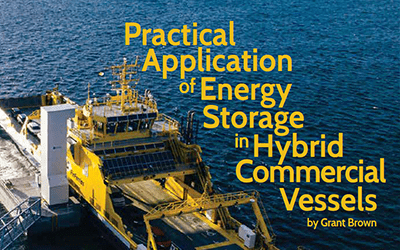
Marine engineers have long been aware of the potential efficiency increases from hybridizing their onboard energy systems; the ability to optimize the use of diesel generators by storing excess energy and using it to provide propulsion during low load times. However, only recently has the battery technology been improved to the point of allowing large-scale systems to survive in a commercial marine environment. Not only do these new energy storage systems survive, they are designed for and excel in commercial marine environments. Hybrid tugboats, offshore supply vessels (OSV), ferries and a variety of other purpose built vessels all derive huge efficiencies from the use of onboard energy storage.
These hybrids range from new builds to retrofits of existing vessels. Payback on investment is a critical component in the decision to convert or build a hybrid workboat. However, an often overlooked benefit is the redundancy and increased safety offered to the operator of a hybrid vessel. A vessel employing a large battery or energy storage system (ESS) not only operates more efficiently, it also has an ability to draw upon a reserve of energy instantly. This pool of energy may be used as spinning reserve to keep the vessel from harm’s way in the event of power loss, provide emergency navigation and hotel loads, auxiliary propulsion power, and even extra bollard pull to the main drives in the event of an emergency situation while towing. While these and other advantages, such as the environmental and cost savings benefits, are well-documented, real world lessons learned by an experienced integration and engineering team are exceptionally valuable. This experience helps vessel owners, operators and designers understand how to design and integrate a lithium energy storage system for safe, reliable use, now and for years to come.
Simply put, batteries will reduce a vessel’s exposure to risk and make it fundamentally safer to operate, while providing economic gain for vessel owners.
Risks of Energy Storage
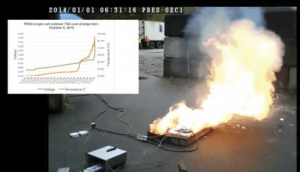
Despite the obvious advantages to a vessel using energy storage to increase efficiency, redundancy and safety, the batteries themselves may pose risk. Due to an event known as thermal runaway, the batteries, if not managed within certain and specific parameters, may pose risk of combustion.
Lithium ion cell forced into thermal runaway – all safety mechanisms disconnected.
Thermal runaway occurs if the lithium-ion cells used in marine batteries are subjected to electrical or mechanical abuse, suffer from internal manufacturing defects, or operate over or under the correct voltage or temperature. Heat is generated within the lithium-ion cells and in cases where this heat exceeds a specific temperature (usually in excess of 120˚ centigrade), the internal structure of the cell begins to degrade. This degradation results in the internal separators melting and thus causes a reaction between the cathode material and electrolyte. This can result in the cell temperature increasing until the cell vents toxic and flammable gases. If ignition occurs, these gases can create an unpredictable fire, which can be very difficult to extinguish.
Therefore it is extremely important to a) reduce risk by designing and manufacturing the highest quality product available, b) reduce risk by managing the batteries in the safest possible way and c) provide a system that is capable of containing and suppressing thermal runaway should it occur. While we have come to accept the risks of maintaining large quantities of flammable diesel on board a vessel, it is due to decades of experience that we now have very little incidence of diesel fire. This is due to trial and error, consistent regulation, and adoption of best practices for management of the systems.
The same learning curve is occurring in the marine industry regarding large-scale lithium batteries. Currently, regulations do not reflect the realities of the size and types of systems that are now being installed and while it is unfortunate, it may take some sort of significant incident to force the industry regulators to adopt stricter regulation.
Fire Suppression
Given the possible issues associated with fire and explosion, the class groups have spent a lot of time focusing on how to prevent and manage fires and thermal runaway. No matter the amount of care that the class rules can apply to prevention, it does not remove the battery manufacturers from the responsibility of incorporating sophisticated prevention systems into the design of the batteries. With lithium energy storage systems now regularly being discussed that exceed several MWh of capacity, the risk of thermal runaway or fire cannot be taken lightly. Today’s hybrid designs must take this into account and do everything possible to ensure that a fire cannot start in the first place. This has created a shift in thinking that is driving designs to incorporate liquid cooling systems. These liquid cooling systems manage battery safety inside the core of the module through temperature control and management at the cell level. Fire suppression is critically important but must be viewed as a secondary system to manage the issue in extreme circumstances, after all else fails. Fire suppression systems therefore are recommended to control external fires adjacent to the energy storage system to prevent them from causing a thermal event in the battery room. If desired, fire suppression in the battery room may also be employed to further give peace of mind as a backup system. Mist type fire suppression provides adequate cooling to suppress virtually any fire (outside of a major catastrophe involving the ship itself) that may pose a hazard to the energy storage system. In order to meet class standards, the energy storage system itself must be rated for IP67 water resistance and therefore able to safely withstand activation and use of mist type fire suppression.
Management Systems, Communications and Controls
Modern battery systems provide an ability to not only integrate with existing systems on board the vessel, but also increase longevity of system life and enhanced safety of the system. These systems reside inside the battery modules and the system controller, which in turn communicates with the other vessel power electronics. The Battery Management System (BMS) is able to predict module lifespan using complex algorithms that incorporate historical data and projected future use. This allows vessel owners to alter their use profile of the energy storage system to a) increase lifespan, b) increase vessel fuel efficiency, or c) a combination of both. The BMS is also an extremely important part of the safety system of the ESS. It constantly monitors the internal core temperature of the modules and if they are going out of spec (too hot or too cold), they will warn the vessel captain to limit use. The BMS is also able to actively monitor the state of health of the system within the temperature warnings; if a specific component in any one part of the entire system is out of spec, the system will warn the captain and the team who is monitoring it. The monitoring team will then proactively engage with the vessel and determine what, if any, course of action need be taken. If the warnings continue without intervention from the team, or if the vessel crew ignores the warnings, the system will protect itself and the vessel by disengaging from the DC bus and isolating all the modules in the system via their internal contactors, effectively reducing system voltage from a maximum of 1,000 V to ~100 V (the voltage of a single module). As the controls are powered separately from the ESS, they are safer in that there is redundancy in the system. It will always have an external power source ensuring the cooling system is operating and the management system is communicating with the vessel and system administrator team at all times, regardless of the system status.
Cooling Systems
While the industry standard for many years was passive cooling on all systems, it is increasingly apparent that the smaller systems demanded by industry are required to operate at, or beyond, the limits of passive cooling. Virtually all modern ESS employ some form of liquid cooling, either as an optional addition to the standard system or as an integral component. Advanced, state of the art ESS use individual cell level cooling systems; the coolant circulates within the very core of the battery module at a low pressure enabling far greater charge and discharge currents, increased lifespans, and reduced system sizes. In fact, the most modern of these systems has been validated to discharge approximately 16 times more power than the current industry standard product. Typically the ESS will connect to a standard chiller of specified size, using an inexpensive and small pump and be able to meet the very high demands with a far smaller system size and capacity with resulting cost savings benefits.
Conclusion
The new breed of hybrid commercial vessel is now a proven workhorse capable of huge economic and environmental benefits in virtually every application it is deployed (Figure 5). The added risk mitigation and increased safety has tangible value that should not be dismissed. No longer is the reduced cost of ownership from the decreased fuel consumption and maintenance outweighed by concerns about safety and reliability. As with any updated technology, lithium energy storage is new and system design is currently being refined, as are class rules regarding the use of the technology. As a co-founder of one of the early companies developing energy storage for hybrid marine systems, I have observed the industry develop, grow and mature. It is my assertion that the technology is gaining momentum by leaps and bounds. As it continues to evolve so will advances in the design and safety of the systems and increasingly strict regulations governing their use. The industry is now producing safe, reliable systems that provide meaningful financial benefits for the owners, safe operation for the crew and, ultimately, huge environmental benefits for the planet.
[vc_row][vc_column][vc_column_text]“In the rush to make technology affordable- we cannot avoid all the necessary steps to stay true to the reality of our markets- Safety is first and paramount always.” Batteries have made incredible progress in the last ten years and are an integral part of the solution- financially, environmentally and socially. Our thoughts go out to all of the first responders affected by this event- godspeed your recovery. – Brent Perry, CEO SPBES
Below is an excerpt from OffShore Engineer published October 15, 2019 by William Stoichevski about the recent battery fire on-board the MF Ytteroyningen. Link to full article here.
A Fire in the Battery Room
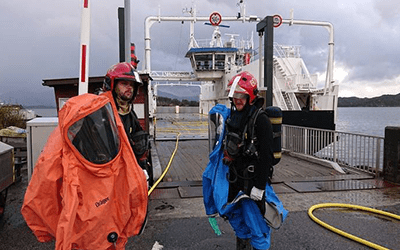
The fire on the night of October 17 occurred just a hundred meters from shore, and “passengers and crew got to land before the situation escalated”, NRK reported. The fire aboard the ferry MF Ytteroyningen, reported by Norwegian national broadcaster NRK, was a stark warning. It escalated. The fire in the battery room was thought to have been extinguished during the night, but an explosion below deck rocked the converted hybrid ferry in the morning. Damage is severe and structural.
The risk inherent in marine energy storage has, however, been known and understood — by a few. Little-known lab tests in Sweden produced fires.
Canadian entrepreneur and shipbuilder Brent Perry, behind both Corvus and PBES (now SPBES), has cautioned about thermal runaway and fumes build-up for years, adding that some competitors don’t understand risks that need to be mitigated via special safety mechanisms.
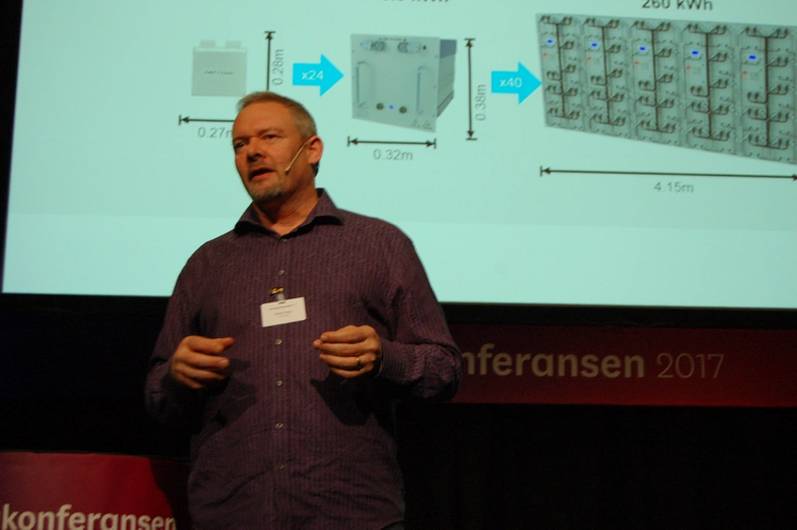
Brent Perry (Photo: William Stoichevski)
Rig risk
The risks need to be thoroughly understood and responded to given the implications of the MF Ytteroyningen fire for rigs or the offshore service vessels hoping to rely on energy storage. Was it the ferry’s battery room construction that caused the explosion and fire? Was it a flaw in the energy storage system itself?
Rig owners and operators need to know what caused the metal-melting battery fire aboard that ferry before more marine batteries are installed on anything destined for an offshore hazard zone. Early investigations reveal the batteries weren’t plugged in.
But what caused thermal runaway in the first place.
Perry once told this author that the systems have to robust enough not to need their own battery rooms, where fumes can gather. Batteries need to speak to technicians, and then they need to be kept at stable temperatures. Their control programming needs to be adjusted.
I’d talk to Perry, as he seems to have written the rules on energy storage safety.
“We monitor these systems 24/7. If we see a slight variation in voltage, we know it before the customer does,” we once quoted him as saying.
“Lithium batteries — although they have extraordinary performance capacity — are very temperature-sensitive beasts.[/vc_column_text][/vc_column][/vc_row]
Marine engineers have long been aware of the potential efficiency increases from hybridizing their onboard energy systems; the ability to optimize the use of diesel generators by storing excess energy and using it to provide propulsion during low load times.
However, only recently has the battery technology been improved to the point of allowing large-scale systems to survive in a commercial marine environment. Not only do these new energy storage systems survive, they are designed for and excel in commercial marine environments. Hybrid tugboats, offshore supply vessels (OSV), ferries and a variety of other purpose-built vessels all derive huge efficiencies from the use of onboard energy storage.
These hybrids range from new builds to retrofits of existing vessels. Payback on investment is a critical component in the decision to convert or build a hybrid workboat. However, an often overlooked benefit is the redundancy and increased safety offered to the operator of a hybrid vessel. A vessel employing a large battery or energy storage system (ESS) not only operates more efficiently, it also has an ability to draw upon a reserve of energy instantly. This pool of energy may be used as spinning reserve to keep the vessel from harm’s way in the event of power loss, provide emergency navigation and hotel loads, auxiliary propulsion power, and even extra bollard pull to the main drives in the event of an emergency situation while towing. While these and other advantages, such as the environmental and cost savings benefits, are well-documented, real world lessons learned by an experienced integration and engineering team are exceptionally valuable. This experience helps vessel owners, operators and designers understand how to design and integrate a lithium energy storage system for safe, reliable use, now and for years to come.
Simply put, batteries will reduce a vessel’s exposure to risk and make it fundamentally safer to operate, while providing economic gain for vessel owners.
Read the full story here. Read more stories from their August issue here.
Excerpt from William Stoichevski article published in Salmon Business. Link to original article here.
Electric Aquaculture Vessels Could Hit Canadian Waters Soon
Electrification of the growing fleet of aquaculture workboats is now underway. Last year the world’s first battery-powered work boat for fish farming was launched with enormous success. The fully electric Elfrida has been operating in the coastal waters of Norway since February 2017.
The vessel, which is powered by 156kWh of PBES Power batteries, provides up to 12 knots speed and a full eight-hour shift per charge. Not only does the system eliminate emissions, the fact there is no noise, vibration or diesel fumes provides greater crew comfort, less fatigue and leads to safer working conditions onboard. Best of all, the vessel requires no diesel fuel, dramatically reducing operating costs.
The Technology Shift Coming to Canada
Stavanger-based Blueday Technology has recently won a contract to deliver the same emissions-cutting technology to the fish-farming operations of Grieg Seafood.
Blueday, formerly Halvorsen Power Systems, integrates batteries into a vessel’s onboard power and propulstion system, while traditionally also providing stationary power generators. Its new SMART Hybrid Power solutions of integrated wind, solar and battery power will, it is understood, replace diesel generators and other aquaculture-related power producers at Grieg’s remote grow-outs like those in British Columbia, Canada.
No More Diesel Leaks in Sensitive Waters
Fish-farmers operating in B.C. have come under harsh criticism for repeat diesel leaks, although diesel generators remain the “preferred” power solution all along the Pacific Northwest, right up through Alaska and the Aleutian Islands. If Blueday can keep costs down, that Pacific preference might change.
Blueday Technology, like onboard power integrators Siemens and ABB, are understood to use the battery technology of Canadian/Norwegian-based PBES Norway, founded by B.C. entrepreneur, Brent Perry. Both Blueday, which offers battery “choice”, and PBES have been along in the conversion of a growing number of Norwegian vessels — from ferries to fishing vessels — to hybrid and fully electric energy conversion.
Battery/electric propulsion systems for ships can provide propulsion and house power for the full route as well as the working day aboard the vessel. This saves not only fuel but also operating costs, because an electric motor requires maintenance much less often than a diesel engine. Furthermore, work on an electric boat is eco-friendly for workers because of the absence of the exhaust gases, vibrations, and noise produced by a diesel engine.
Grieg’s use of Blueday’s solution in Canada could be timed to perfection, as the Canadian government has just allotted millions of dollars for small and medium-sized fish farmers to get “greener” by investing in more energy-efficient designs of all sorts. The Blueday communique wasn’t clear on the configuration of the “green power” solution in their Grieg contract, but stationary power for Grieg sites in Canada is implied here. Grieg Seafood will now be greening fish farming assets and reducing greenhouse gas emissions,” Heggebo was quoted as saying.
Ulsteinvik, Norway – ABB will optimize the safety and environmental credentials of a new Louis Dreyfus Armateurs wind farm Service Operation Vessel (SOV) by installing Onboard DC Grid power distribution to enable the cost-efficient integration of batteries. As an integral part of the power system, the Power and Energy Management System (PEMS) will ensure safe and efficient operation of the vessel. The hybrid system enables lean operation with fewer running generators without compromising on safety, meaning less maintenance and better fuel consumption over the long-term.
“Shipping is waking up to the many advantages of energy storage,” said Juha Koskela, Managing Director of ABB’s marine and ports business. “With the industry starting to use batteries more and more, and fuel cells becoming a viable option, we fully expect the Onboard DC Grid to gain further traction.”
The Onboard DC Grid will integrate two sets of batteries used primarily for spinning reserve and peak shaving. Power peaks during operation can be covered by the battery rather than starting another engine. Again, battery power can act as backup for running generators, reducing the need to run spare generator capacity. In addition to ship efficiency gains, the mode of operation has long-term benefits for ship engines, as it increases efficiency through higher engine load and reduces running hours overall.
PBES Powers World First Electric Aquaculture Support Vessel
Plan B Energy Storage (PBES) today announced a milestone project in the aquaculture industry. The award of the contract for energy storage aboard the electric fish farm vessel Elfrida underscores the ongoing trend toward adoption of green technology in Norway.
“We see this as crucial preparation for a low-carbon future,” says Roger Bekken, Managing Director of Salmar, the vessel’s owner and leading Norwegian aquaculture company. “In keeping with our forward thinking management, and focus on operational efficiency, adding battery technology to our vessels brings cost savings and environmental stewardship together in one package.”
“The PBES battery system onboard Elfrida was one of the first we installed in a working vessel and proves the technology is well suited to fish farming,” said Grant Brown, Vice President, Marketing at PBES. “We envision the entire fleet of Norwegian aquaculture and fishing vessels to either run as hybrid or on full battery propulsion,” he added.
In operation since February 2017, the vessel provides up to 12 knots speed and a full eight-hour shift per charge. Not only does the system eliminate emissions, the fact there is no noise, vibration or diesel fumes provides greater crew comfort, less fatigue and leads to safer working conditions onboard. Best of all, the vessel requires no diesel fuel, dramatically reducing operating costs.
Article written by Stevie Knight, post on MaritimeJournal.com on July 6, 2017
Will the WSFVs of the future run on batteries?
“When you look at the considerations for WFSVs,” said Andrew Eydt of PBES, “Human safety as well as operational concerns are top, and what you want for both is redundancy that’s key.”
However, the high speed transits are fairly long, so the batteries can get another chance at a top up and there’s plenty of time to absorb it without demanding more from the engine capacity.
This is often followed by hours of relatively short transits between towers and extended periods of loitering around the windfarms on standby. “This low-speed loitering presents a very inefficient loads cycle for the engines,” pointed out Mr Eydt. However, while the ‘pushing on’ element of engaging with the towers is a typically low engine load scenario, there are typically sudden changes as the waters surge across the foundations – here, it seems that batteries’ ability to respond in milliseconds might yield important, hitherto unexplored, advantages.
Of course, there’s the unpredictability of the operational pattern which is where hybrids again win: even if the onsite manoeuvring continues for an extended periods, it’s possible to cycle energy storage and engines alternately.
All this makes a very good case for batteries or does it?
What has put many operators off is the physical footprint of the energy solutions and those unpredictable operational matters make WSFV designs particularly weight conscious – and operators wary.
However, battery technology has shaped up a great deal in just a few years, doubling output for the same weight, and also halving in price. What has put many operators off is the physical footprint of the energy solutions and those unpredictable operational matters make WSFV designs particularly weight conscious – and operators wary. However, battery technology has shaped up a great deal in just a few years, doubling output for the same weight, and also halving in price.
“Long term strategy and sustainability is the same thing”
Low and zero emissions technology in the maritime sector has gained a lot of attention in recent years, especially in Norway. The increase of electric systems in different applications is considered a key opportunity for Norway to sustain their leadership role in maritime technology development. At the forefront of this development is Erik Ianssen, the man who in 2012 decided to build the world’s first battery powered fishing vessel in Trondheim, Norway.
With the goal of reducing Norway’s diesel consumption by 80 million liters, there is no lack of ambition. Ianssen is convinced that new technology is the key to achieving this goal, and that the city of Trondheim will play an important role in this technology development:
I believe the time is long overdue for a technology transformation in the maritime sector, and Trondheim has a great opportunity to become the national center for this technology development. –Erik Ianssen, Founder and CEO of Selfa Arctic
The European offshore wind farm industry is booming. In 2015, 3,10MW of grid-connected capacity was added, 108% more than in the last 10 years! With this growth comes a need for evolution in service vessels that support the industry. Energy storage technology is a major part of the current evolution of the maritime industry; hybrid and fully electric systems have successfully been installed on a variety of commercial vessels including ferries, offshore support vessels, fish boats, and tugboats. While environmental regulations have helped to create demand for this sustainable technology, the primary market driver is increased safety and reliability of the vessels and a significant decrease in operational and fuel costs.
Rough weather and high waves often characterize the working environment for people and equipment during the installation, and maintenance of offshore wind farms. This means that wind farm services vessels have extraordinary requirements for immediate power, endurance, robustness and safety in order to maintain their operational duties in all weather. A service vessel requires powerful bollard pull capabilities, and in general excellent sea keeping abilities to withstand wind, waves and currents. In these demanding environments, human safety as well as operational expenditures are of key concern, thus service vessels must be built to the highest standards.

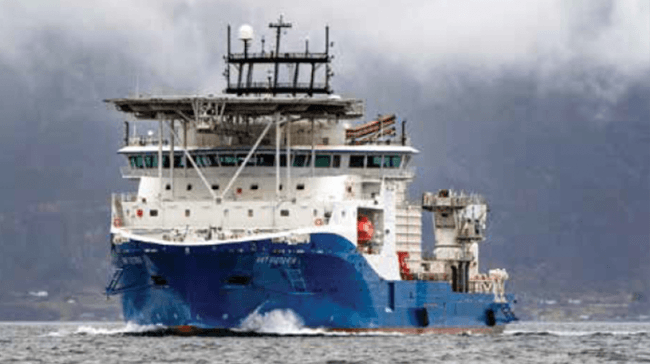


 Plan B Energy Storage (PBES) today announced a milestone project in the aquaculture industry. The award of the contract for energy storage aboard the electric fish farm vessel Elfrida underscores the ongoing trend toward adoption of green technology in Norway.
 “The PBES battery system onboard Elfrida was one of the first we installed in a working vessel and proves the technology is well suited to fish farming,” said Grant Brown, Vice President, Marketing at PBES. “We envision the entire fleet of Norwegian aquaculture and fishing vessels to either run as hybrid or on full battery propulsion,” he added.
 Will the WSFVs of the future run on batteries?
 Rough weather and high waves often characterize the working environment for people and equipment during the installation, and maintenance of offshore wind farms. This means that wind farm services vessels have extraordinary requirements for immediate power, endurance, robustness and safety in order to maintain their operational duties in all weather. A service vessel requires powerful bollard pull capabilities, and in general excellent sea keeping abilities to withstand wind, waves and currents. In these demanding environments, human safety as well as operational expenditures are of key concern, thus service vessels must be built to the highest standards.