Author: Shift Team

  • PBES Announces Contract Manufacturing with Elpro Solutions

    PBES Announces Contract Manufacturing with Elpro Solutions

    PBES Norway battery production moves to established Trondheim manufacturer

    PBES and Elpro Solutions AS (Elpro) today announced that they have entered a manufacturing agreement for PBES battery systems. The agreement with Elpro provides PBES with the ability to meet the demand for its product with greater manufacturing capacity, agile and flexible factory set up, and the quality standard demanded by our customers.

    After nearly 2 years of manufacturing in Norway, it became apparent that our customers would be better served by a more streamlined process.” said Brent Perry, CEO, PBES. “The most important thing was making sure our customers can rely on delivery of product and the highest quality service. The combination of Elpro’s long experience in the maritime industry and ability to manufacture to the highest quality standards and PBES ability to service its products and customers delivers the best of all worlds to the growing maritime markets globally.”

    “Elpro is pleased to announce this agreement with PBES and demonstrates Elpro’s capabilities and competitiveness in the maritime market,” stated Pål Rune Johansen, CEO, Elpro Group AS. “I have been impressed with the level of innovation and quality of PBES technology and products. PBES growth rate and position in the business within the rapidly expanding energy storage sector is an adventure of its own and Elpro looks forward to playing a significant role in the business of green technology” concluded Mr. Johansen.

    The PBES energy storage system has been designed to the highest standards of performance, safety and sustainability. It is designed to seamlessly integrate with all types of power generation in a variety of applications, at sea and on land.


    About Elpro Solutions

    Elpro Solutions is a trusted partner to some of the world’s most demanding system integrators of electro technical solutions within the maritime, onshore, offshore and aquamarine industries.

    www.elpro.no

  • PBES’ First Norwegian Batteries Celebrate 1 Year Operational Milestone

    PBES’ First Norwegian Batteries Celebrate 1 Year Operational Milestone

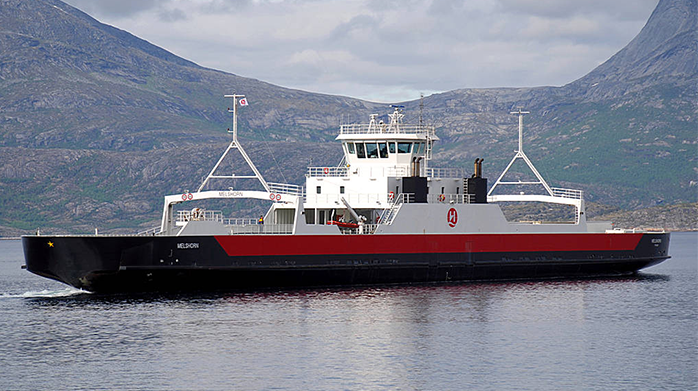
    MF Melshorn

    PBES is proud to acknowledge the first year of operation of the hybrid ferries Melshorn and Vardehorn. The two sister ships were built in 1999. In late autumn 2016 they were rebuilt with hybrid propulsion using PBES energy storage at Havyard yard (Sogn og Fjordane). The two vessels re-entered service in January 2017.

    Melshorn and Vardehorn provide an important role in Norway’s transition to clean transportation,” said Grant Brown, Vice President Marketing at PBES. “They prove that commercial transportation need not be dirty and inefficient. Energy storage is an important part of this transition and PBES is proud to be providing the best quality, Norwegian built energy storage in the industry.”

    MF Valderhorn

    The low-emissions ferries are part of the ongoing push for zero to low emission public transportation in Norway. Each 102m vessel can carry 120 automobiles and 350 passengers. The Melshorn operates onthe 25-minute crossing on E6, Bogenes to Skarberget and Vardehorn runs the 45-minute crossing R827, Drag to Kjøpsvik. Each vessel contains 520kWh of PBES Power 65 batteries providing 1000V to the DC bus.

    In 2017 PBES installed more than 15MWh of energy storage to marine markets around the world, making it the leader in delivered product in the industry. The PBES energy storage system has been engineered to the highest standards of performance and safety and is designed to seamlessly integrate with electrical infrastructure on any vessel.


  • China’s Newest Battery Hybrid Port Crane

    China’s Newest Battery Hybrid Port Crane

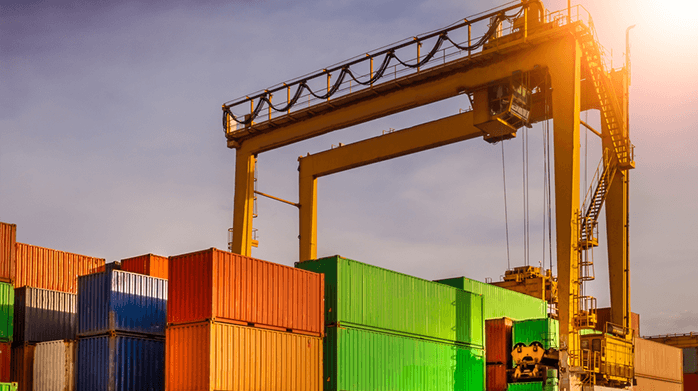
    PBES is proud to announce the successful installation and commissioning of the first rubber tyre gantry crane with China Communications Construction Company (CCCC). CCCC is the world’s largest manufacturer of port container cranes, exporting to freight terminals around the globe. CCCC Shanghai Equipment Engineering Co., Ltd (CCCCSH) is a subsidiary of CCCC and is located in Shanghai.

    “PBES is exceptionally pleased to work with CCCCSH on this innovative project,” said Brent Perry, CEO, PBES. “This first project validates the quality, performance and safety PBES has become known for. We look forward to a long, prosperous relationship with CCCCSH going forward.

    Low-emissions container cranes are part of the global push to reduce emissions from port operations. RTG container cranes are particularly well suited to hybridization; 24-hour use and rapid cycling combined with huge capacity to create regenerative power means that only the most robust batteries are up to the task. Hybrid cranes reduce fuel consumption by hundreds of thousands of liters of fuel per year compared to traditional diesel only versions. They are very effective in emissions reductions and at the same time provide significant operational cost savings.

    “PBES batteries have proven capable of handling high charge and discharge rates, and also of providing the longevity that is required in a busy port application,” commented Gao JianZhong, Chief Engineer CCCCSH. “The unparalleled cycle life and exceptional commitment to service from PBES sets them apart from other battery companies.”

    In 2017 PBES installed more than 15MWh of energy storage to marine and industrial markets around the world. The PBES energy storage system has been engineered to the highest standards of performance and safety and is designed to seamlessly integrate with the electrical infrastructure on the machine.


    About PBES

    PBES designs and manufactures high power lithium-ion energy storage. Comprised of the most experienced team in the sector, PBES is focused on providing value and safety for industrial, marine and grid energy storage applications. www.ssssspbes.com.

    About CCCC

    China Communications Construction Co. Ltd. engages in the design and construction of transportation infrastructure, dredging and heavy machinery manufacturing business. The company was founded on October 8, 2006 and is headquartered in Beijing, China. www.ccccltd.cn

    About CCCCSH

    CCCC Shanghai Equipment Engineering Co., Ltd (CCCCSH) was founded in 1998 as one of subsidiaries of China Communications Construction Company Ltd. (CCCC). Relying on the background advantage of CCCC, CCCCSH is mainly engaged in EPC of ships and port machinery, including engineering, manufacture, installation, commissioning and repairing. In addition, CCCCSH also deals with battery system application on port machinery. www.ccccsh.com

  • Batteries for ferries and vessels is in big growth – Two leading manufacturers are dominating todays market

    Batteries for ferries and vessels is in big growth – Two leading manufacturers are dominating todays market

    According to Maritime Battery Forum the growth of maritime batteries is exceptional – Growth is at 30%

    Translated version – Original article by Tore Stensvold –Published: 24. Jan. 2018 

    Suppliers of Energy Storage Systems within the Maritime Industry, grows along with the electric development of ferries and hybrid engineering for Offshore Industry. It all started with the electric ferry Ampere, by Norled in 2015. More vessels are to come with battery solutions on-board.

    Today 203 vessels in the civilian and commercial market are installed with energy storage systems that either partly or fully replace the need of fossil fuels. Two suppliers are dominating todays market: all together Corvus and PBES supply more than 50%. It´s a long way down to number three, four and five. That is French SAFT, Dutch EST-Floattech and Norwegian ZEM. And new suppliers are breathing down their neck.


    Electric Ferry, Ampere, started its journey in 2015 on the route of Sognefjorden along E39, Lavik-Oppedal. (Picture: Tore Stensvold)


    Canada and Bergen:

    Corvus Energy last year sold energy systems all together 50MWh capacity to 50 vessels. The year before that, 2016, their total sales were 5,5MWh. The HQ, production line and development is based in Vancouver. Most of sales, service and marketing is in Bergen. Sales Manager Halvor Hauso for Corvus says that 2018 will be a bigger sales year than their record year of 2017. Budget figures and targets for 2018 are not yet ready, as Corvus has a deviating financial year.

    • So far it looks like number of MWh sold will grow in the year 2018, says Hauso to TU. 
    Canada and Trondheim:

    The second biggest supplier, Plan B Energy Storage(PBES), delivered a total of 15,3 MWh for a total of 20 energy storage systems in 2017. PBES built their production line in Trondheim and most of the engineering and sales is in Norway.

    VP Brand and Marketing, Grant Brown for PBES says to TU that they see a big growth for the sales figures of 2018.

    • “We already have 11 orders totalling 9 MWh and anticipate far more sales through the electrical system integrators, “said Brown.
    Germany and Trondheim:

    One of the new suppliers of maritime batteries is Siemens. Siemens has developed their own batteries and is starting production in Trondheim soon. Other system integrators consider the same. Swedish Echandia Marine, that delivered the electrical systems for coastal express BB Green, has published that they are engineering both lithium-titan-oxide and nickel-metal-hybrid batteries.

    Adaptation and Focus:

    Norwegian ZEM Energy is not that happy with Siemens building their own production line for maritime batteries. ZEM distributed batteries for Siemens project´s. In the future, it might be fewer of their distribution to Siemens.

    • The competition has expanded, Siemens addition to supply has not minimalized it, says Egil Mollestad for ZEM.

    Last year the company delivered Energy Storage Solutions together for roughly 3 MWh. A tougher competition ZEM will have with new types of batteries.

    • Throughout 2017 we developed a battery solutions for smaller vessels, small passenger ferries, workboats and similar. So far in 2018 we have two orders for these types of systems. We see it as an important and exciting market where we don’t have competition from the bigger suppliers Siemens, Corvus and PBES, said Mollestad.

    ZEM cooperates with Norsafe with development of battery driven lifeboats.


    The most important for offshore lifeboats is to quickly get away from the platform. Batteries is a excellent solution. (Picture: Norsafe)


    Crew Doubled:

    Grenland Energy is the smallest Norwegian battery supplier. They do the same as ZEM, develops and points systems to new market segments. In 2017 Grenland Energy supplied battery systems for two mobile, active HIV subversion subcomponents, but no ships. That is going to turn.

    • We have expanded and doubled the crew from five to ten employees. WE have been working allot with development and testing of a new generation batteries with a higher energy density, said Roman Stoiber, Grenland Energy.
    Fire Safety:

    The new batteries have been tested by the Norwegian Maritime Directorate´s propagation test1. The tests are very strict and shall prevent so-called Thermal Runaway, overheating and fire that can spread between the cells in lithium batteries.

    Battery Management Systems that passes the test, have integrated safety systems which makes it unnecessary with extra fire and explosion safety inside the vessel.

    • We are fully committed to the maritime market with the new generation and have the first order ready for delivery to Norleds Hybrid coastal express which is to be ready in 2019, said Stoiber to TU.

    The company is also working with two new Pilot E-Projects, NCE Maritime Clean Techs “Urban Water Shuttle” and autonomous ferries with Kongsberg Maritime. Hybrid Sacandlines-Ferry. The battery pack from Corvus is 2,7 MWh, here from Princess Benedikte after installation is complete. (Picture: Scandlines)

    New Markets:

    Daily Manager Sondre Henningsgård at Maritime Battery Forum sees that batteries are coming along well inside of new segments.

    • Ferries, passenger vessels and hybrids in the offshore business is still the biggest market. At the same time, it is clear that smaller vessels such as tugboats, luxury yachts and workboats are installing battery systems.

    PBES announced last week a contract for battery system to an Estonian police patrol boat and border control vessel.

    It´s a hybrid vessel, 44,6-meter-long and total weighs 220 metric ton. The propulsion system is 2 x 2000 kW and main engines is MTU 16V4000. Installation of the battery system will be in March this year and the size of it is 273 kWh. The German company Noris is the system integrators and ordered the batteries from PBES.

    Noris and PBES has signed a cooperation agreement, which resulted in yet another contract. PBES are delivering a battery package for 137 kWh to a smaller Swedish ferry. Both the ferry and patrol boat is being built at the Baltic Workboat Shipyard in Estonia. Both vessels will be delivered within 2018.

    Norwegianisation:

    Corvus was established in Vancouver, Canada in 2009. One of the founders, Brent Perry, joined forces to couple others after a few years out of the company and started Plan B Energy Storage.

    Last check and documentation (Picture: Tore Stensvold)

    Perry thought of Norway as a leaders for electric vessels and ferries. Through a delivery of Corvus batteries to the world´s first electric fishing boat, Perry met with CEO in Selfa, Erik Ianssen. The relations to Norway and Trondheim led to the establishment of the factory in Trondheim.

    Meanwhile Corvus is becoming more Norwegian. Statoil Technology Invest, BW Group and Hydro owns roughly 70% of stocks. Last one to buy in was Hydro, bought 25,9% stocks in November 2017. From 1. Jan. 2018 administrative director will be a Norwegian. Geir Bjørkeli came from the Dutch Huismans Norwegian offce and is now based in Bergen.

    PBES keeps their Canadian ownership, but are moving more of their activity to Norway.


  • Eco Friendly Electric Propulsion Coming to Canadian Aquaculture Industry 

    Excerpt from William Stoichevski article published in Salmon Business.  Link to original article here.

    Electric Aquaculture Vessels Could Hit Canadian Waters Soon

    Electrification of the growing fleet of aquaculture workboats is now underway. Last year the world’s first battery-powered work boat for fish farming was launched with enormous success. The fully electric Elfrida has been operating in the coastal waters of Norway since February 2017.

    The vessel, which is powered by 156kWh of PBES Power batteries, provides up to 12 knots speed and a full eight-hour shift per charge. Not only does the system eliminate emissions, the fact there is no noise, vibration or diesel fumes provides greater crew comfort, less fatigue and leads to safer working conditions onboard. Best of all, the vessel requires no diesel fuel, dramatically reducing operating costs.

    The Technology Shift Coming to Canada

    Stavanger-based Blueday Technology has recently won a contract to deliver the same emissions-cutting technology to the fish-farming operations of Grieg Seafood.

    Blueday, formerly Halvorsen Power Systems, integrates batteries into a vessel’s onboard power and propulstion system, while traditionally also providing stationary power generators. Its new SMART Hybrid Power solutions of integrated wind, solar and battery power will, it is understood, replace diesel generators and other aquaculture-related power producers at Grieg’s remote grow-outs like those in British Columbia, Canada.

    No More Diesel Leaks in Sensitive Waters

    Fish-farmers operating in B.C. have come under harsh criticism for repeat diesel leaks, although diesel generators remain the “preferred” power solution all along the Pacific Northwest, right up through Alaska and the Aleutian Islands. If Blueday can keep costs down, that Pacific preference might change.

    Blueday Technology, like onboard power integrators Siemens and ABB, are understood to use the battery technology of Canadian/Norwegian-based PBES Norway, founded by B.C. entrepreneur, Brent Perry. Both Blueday, which offers battery “choice”, and PBES have been along in the conversion of a growing number of Norwegian vessels — from ferries to fishing vessels — to hybrid and fully electric energy conversion.

    Battery/electric propulsion systems for ships can provide propulsion and house power for the full route as well as the working day aboard the vessel. This saves not only fuel but also operating costs, because an electric motor requires maintenance much less often than a diesel engine. Furthermore, work on an electric boat is eco-friendly for workers because of the absence of the exhaust gases, vibrations, and noise produced by a diesel engine.

    Grieg’s use of Blueday’s solution in Canada could be timed to perfection, as the Canadian government has just allotted millions of dollars for small and medium-sized fish farmers to get “greener” by investing in more energy-efficient designs of all sorts. The Blueday communique wasn’t clear on the configuration of the “green power” solution in their Grieg contract, but stationary power for Grieg sites in Canada is implied here. Grieg Seafood will now be greening fish farming assets and reducing greenhouse gas emissions,” Heggebo was quoted as saying.

  • PBES Energy Storage Power Norway’s Newest Battery Electric Ferries

    PBES is proud to announce the successful installation of two 1MWh battery systems aboard the new electric ferries that service the E39 highway route on the 2km crossing between the Anda and Lote docks. The M/F Gloppefjord and Eidsfjord are Norway’s latest battery-operated ferries.
    “Anda-Lote is a vital link for Western Norway,” said Grant Brown, Vice President Marketing at PBES. “We are extremely happy to have been chosen to supply powerful and reliable PBES batteries for these innovative vessels. PBES remains committed to providing the best quality, Norwegian built energy storage for the ferry industry.”

    The zero-emissions ferries are part of the ongoing push for zero and low emission public transportation in Norway. Each 106m vessel can carry 120 automobiles and 349 passengers on the 8-minute crossing.

    In 2017 PBES installed more than 15MWh of energy storage to marine markets around the world, making it the leader in delivered product in the industry. The PBES energy storage system has been engineered to the highest standards of performance and safety and is designed to seamlessly integrate with the electrical infrastructure on the vessel.

  • A battery-driven ferry that promises to clean up the market in more ways than one.

    A battery-driven ferry that promises to clean up the market in more ways than one.

    Excerpts from Stevie Knights articles published in Maritime Journal.  Links to original article here.

    New tech comes with a price, but there’s a lot resting on it – all the more so when it concerns a commercial, battery-driven ro-ro that promises to clean up the market in more ways than one.

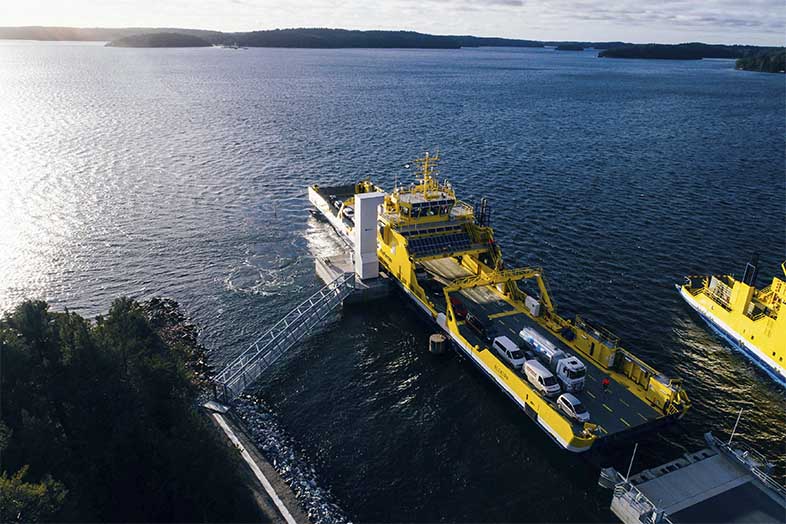
    The power for Finland’s new battery ro-ro, Elektra is the 1MW PBES energy storage system, split into two banks, powering a pair of 900kW, Z-drive, azimuthing thrusters from Rolls-Royce: “These mean Elektra can actually move sideways, so it’s easy to manoeuvre,” said Mats Rosin, FinFerries’ CEO. The 97.92m Elektra needs to be a 24/7 workhorse as it’s expected to run four times an hour during peak hours and once an hour overnight. The 1.6km ‘gateway’ between Parainen and Nauvo has between 600,000 and 800,000 vehicles crossing a year including heavy goods trucks but a sharp summer spike means over 100,000 vehicles in July alone.

    There are recharging points at both the Parainen and Nauvo turnarounds; a Cavotec vacuum mooring system and recharging tower combo holds Elektra in place while allowing a plug to descend from above to mate with Elektra. The 20kV of power is delivered to a transformer some 150m from the charging tower which reduces it to 690V AC for transfer to the ship. The grid had been recently strengthened nearby, and so it was able to deliver the necessary charge.

    The 160 6.5kWh PBES Power batteries have been lined up for an installed total of 1,040kWh at 1,000V on the DC bus. Elektra uses roughly 125kWh from shore every 30 minutes.  However, the batteries could absorb power at quite a rate as the banks can comfortably charge at 3C, so they could, theoretically, fully charge from empty in 20 minutes. This is partly because the batteries are liquid cooled; after all, putting a bolt of energy through even capacious batteries can shorten the cell’s lifetime.

    https://www.youtube.com/watch?v=RB6rKP34Mtk

    It’s not seawater from outside but rather a closed loop of tightly temperature-controlled tap water (the region’s domestic supply being incredibly pure and uncontaminated).

    More, as depth of discharge also affects the cells’ lifetime, these too are being rigorously bracketed, with the top rising to no more than 80% and the bottom sinking no lower than 60% of the total capacity. Of course, Siemens’ will be watching, monitoring all this and more via a Cloud link.

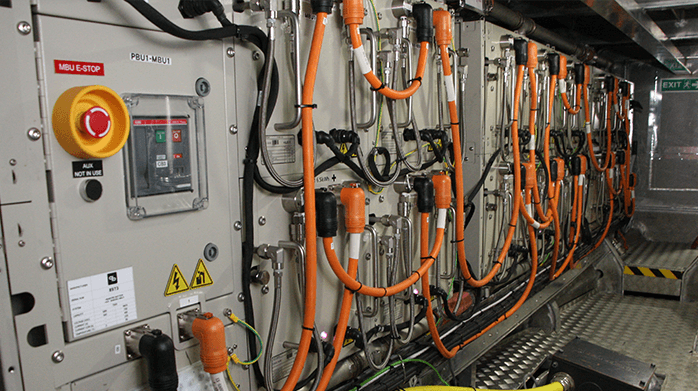
    It’s nice that while Siemens ties battery information together on the touchscreens mounted in both the bridge and power control room, PBES has also installed easy-to-read data displays on each case, showing heat, loading rate, state of charge, state of health and so on, not just for that battery alone but for the whole bank.

    The new ro-ro also is fairly comfortable to operate, just as well since the shifts are 12 hours long, with just a captain, engineer and deckhand onboard. It’s quiet: even in the so-called ‘engine room’, there’s normally no need to raise your voice, the only residual vibration comes from the 900kW Rolls-Royce Z-drive thrusters although there are three auxiliary gensets for redundant power for charging failures or ice conditions.

    Despite the investment, pegged at around 20mEuro for the total project including infrastructure, Elektra’s very cheap to run – based on Ampere’s figures it probably costs no more than a handful of Euros for each recharge. The most important thing about ‘Elektra’, Finland’s new, double-ended ferry is that it paves the way for a new breed of vessel.

  • PBES Batteries Power Finland’s First New-build Battery Electric Ferry

    Winter in Finland won’t stop Elektra from meeting her mission

    PBES is proud to announce the contract, supply, and installation of the 1MWh battery on Elektra. Launched in June of 2017, the vessel celebrates 6 months of service and is Finland’s first purpose built battery electric ferry.

    “PBES energy storage provides Elektra with clean, quiet, fossil free power,” said Grant Brown, Vice President Marketing at PBES. “Due to patented CellCoolTM technology the battery may be recharged in 5 minutes and at end of life it may be refurbished and upgraded to reduce electronic waste using PBES CellSwapTM.”

    Elektra has an overall length of 98m, beam of 15m and draft of 3.55m, with five lanes to accommodate up to 90 cars. She travels her 1.6 km route across the Finnish archipelago year round. Due to heavy ice conditions in the winter months, she carries auxiliary power generation equipment to augment the battery when needed.

    In 2017 PBES installed more than 15MWh of energy storage to marine markets around the world, making it the leader in delivered product in the industry. The PBES energy storage system has been engineered to the highest standards of performance and safety and is designed to seamlessly integrate with the electrical infrastructure on the vessel.


  • The Road to Validation – PBES Thermal Runaway Prevention Testing

    By Aubrey van der Hoven, Senior Manager: Compliance and Quality Assurance, PBES

    Globally, the marine industry has begun the migration to lithium-ion battery technology as an economical and environmentally acceptable alternative to fossil fuel propulsion. PBES is at the heart of this transition with its leading-edge technology [CellCool™, Thermal-Stop™, E-Vent™, etc.].

    However, PBES technology would have had no role in this, unless it had been validated by the regulators of the industry, which include the United Nations, the International Maritime Organization [IMO] or authorized administrations, government agencies [Norwegian Maritime Authority (NMA), Danish Maritime Authority (DMA), etc.], and the classification societies [DNVGL, Lloyd’s Register (LR), etc.].

    Witnessed testing started November 2015, and was completed in August 2017.

     Propagation / Internal Thermal Event Testing

    For a moment, turn back time to October 1st, 2015. The PBES test team was huddled together in a closed container on a remote corner of a foothill of mount Crickmer, a specialized fire test site outside Vancouver, British Columbia.

    Fifty metres away from the container, on the other side of a 9-foot concrete wall, the PBES battery was being overcharged. No one could go outside the container.

    The worst was expected and prepared for – an internal short, rapid release of gas, and an explosion that would send shrapnel flying in all directions…

    The test site was evacuated, up to 420 metres away.

    The internal short happened, but there was no rapid release of gas, no thermal runaway, and no explosion. Hazardous gas released was too little to be detected by the flow meter or pressure transducers. Several subsequent tests produced the same result. It became clear that the thermal runaway prevention measures were very effective.

    The next step was to capture the hazardous gas in bags to measure its volume. Tests were moved indoors. The quantity of hazardous gas released was still too low for the bag sizes.

    There was only one measure left, and that is to fill a beaker with water, and allow any hazardous gas released to displace the water. Finally, we managed to capture less than a liter of hazardous gas released over less than 30 seconds.

    For DNVGL and NMA witnessed tests, we overcharged two batteries and three batteries respectively.

    The results were so uneventful, that NMA requested PBES to showcase 3 more tests of what would happen to a single cell that is not protected by our technology. All three tests without our technology resulted in a dramatic thermal runaway event and fire.

    Market Acceptance

    PBES currently has 11.3 MWh class certified installations [DNVGL, LR] on 11 vessels, certified by the relevant maritime authorities [NMA, DMA], of which Tycho Brahe [4.16 MW] is the largest hybrid electric ferry in the world. Our ESS is DNVGL Type Approved, and is manufactured in an ISO 9001:2015 certified facility.

  • PBES Earns ISO 9001:2015 Certification

    PBES reaffirms ability to consistently deliver effective quality management systems and drive ongoing product improvements

    Trondheim, Norway – 21 November, 2017 – PBES (Plan B Energy Storage) today announced certification to the ISO 9001:2015 standard. Following its corporate mantra of continual improvement and highest quality possible, PBES spent the last year refining its documentation and process, culminating in ISO 9001:2015 certification by DNV GL Business Assurance Norway AS.

    “Our goal is to provide our customers the safest, highest quality industrial energy storage products,” said Brent Perry, CEO PBES. “By obtaining the ISO 9001:2015 certification, we are demonstrating our commitment to our clients’ successes, as well as our dedication to making our own organization more efficient. As a result, we can better serve our customers and make our own operations more efficient.”

    “We are pleased to announce ISO 9001:2015 certification by PBES,” stated Rikke Mohn Simonsen, Key Customer Manager, Sales & Marketing
 DNV GL, Business Assurance. “After careful evaluation and in house audits, PBES has proven to meet ISO standards for certification.”

    The PBES energy storage system has been designed to the highest standards of performance, safety and sustainability. Featuring PBES’ patented CellCool cell level liquid cooling, ThermalStop anti-propagation barrier, E-Vent gas venting system and CellSwap battery re-coring, it is designed to seamlessly integrate with all types of power generation in a variety of commercial and industrial applications.


    About DNV GL

    Driven by its purpose of safeguarding life, property and the environment, DNV GL enables organizations to advance the safety and sustainability of their business. Operating in more than 100 countries, the company’s 16,000 professionals are dedicated to helping their customers in the maritime, oil & gas, energy and other industries to make the world safer, smarter and greener.

    https://www.dnvgl.com/assurance