The Danish shipping
company MHO-Co is heading a consortium that will spend EUR 4.5 million during
the next three years on developing green solutions for the future of the
maritime industry. Together with Aalborg University, among others, and with
grants from the Energy Technology Development and Demonstration Program (EUDP),
MHO-Co will test fuel cells and new battery technology on the shipping
company’s advanced hybrid vessels.
“The aim is to develop environmentally-friendly
technology to replace fossil fuels and dominate the maritime industry in the
future. With the EUDP grants as well as with knowledge and innovation from
other participants, we will set new standards for what is possible in the
maritime industry,” says director of the shipping company MHO-Co, Mik
Henriksen.
The Danish shipping company is the initiator of
the consortium which, apart from the companies Danfoss, Ballard Power Systems Europe A/S,
Sterling PlanB Energy Solution and Stuart Friezer Marine, consists of research
engineers from Aalborg University. They have joined forces on the project at a
total of EUR 4.5 million, of which EUR 2.15 million are grants from the Energy
Technology Development and Demonstration Program (EUDP).
Fuel cells and
batteries
Over the next three years, the six partners
have an ambitious plan to develop and test a propulsion system for maritime
transport that does not emit carbon dioxide. During this period, MHO-Co will
test both fuel cells and liquid cooling system batteries.
Ballard Power Systems Europe
A/S will develop the
first fuel cells for shipping.
“Based on our experience with fuel cells for
heavy transport, we are now focusing on how fuel cells and hydrogen can also
become the green solution of the future in the maritime sector. This project is
groundbreaking because together we can test the different options and find a
sustainable solution, which can be approved by the authorities and
live up to the current requirements for new technologies,” says Kristina Fløche Juelsgaard,
director at Ballard
Power Systems Europe A/S.
Another pillar of the project is the use of
energy storage systems for maritime use. This is where Sterling PlanB
contributes to the project.
“Sterling PlanB has long prided itself on
engineering the safest and most robust energy storage systems available on the
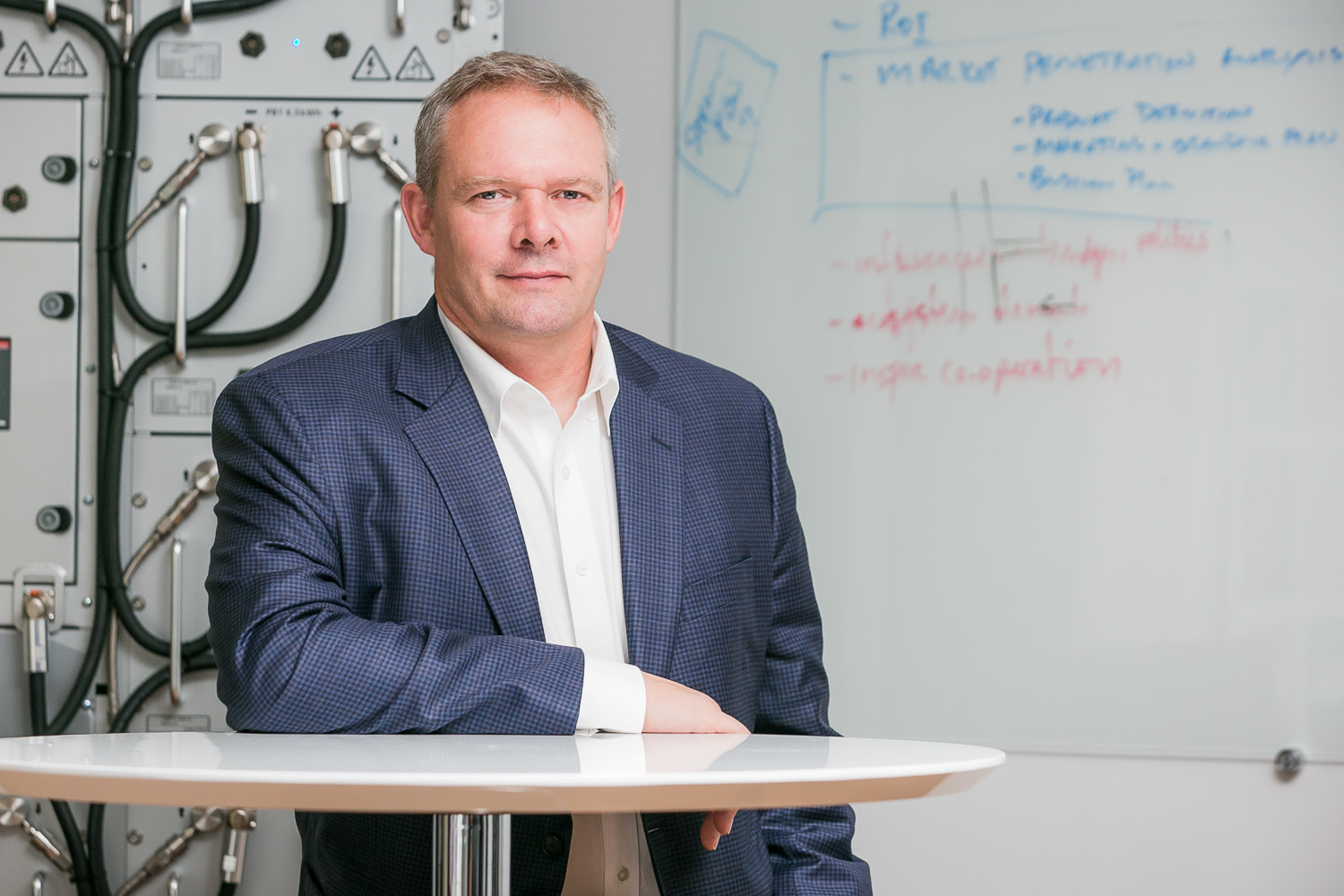
market, in support of emissions reductions,” said Brent Perry, CEO of Sterling
PlanB. “Our battery technology is engineered to
be the most robust lithium battery possible, for a cost-effective, sustainable
solution. We’re very proud to be a part of this project and partnering with
like-minded experts in the industry to support shipping’s decarbonisation
challenges.”
Floating test platforms
The next generation of MHO-Co’s vessels are custom designed to service the wind turbine and offshore industries, and the shipping company specializes in transporting technicians to and from large wind farms. Currently, the shipping company is building the world’s first Crew Transfer Vessels with hybrid propulsion, and these two vessels will be the focal point of the project.
“Our two new vessels are built as floating test platforms. They are designed to be adapted to the environmentally-friendly energy systems of the future – simply by replacing engine and propulsion packages. And since the vessels are catamarans, we have four platforms providing even better conditions for testing and comparing different sustainable solutions, “Mik Henriksen (MHO-Co) explains. The two new vessels are being built in China and are scheduled to be put into operation in Europe before the summer holidays of 2021.
ABOUT MHO-Co
MHO-Co is a Danish shipping company specializing in the service and transport of crew in the offshore wind industry. The shipping company was founded in Esbjerg in 2015 by Mik Henriksen and commands a number of vessels including the twin vessels MHO Gurli and MHO Esbjerg, which – each measuring 39 meters – are the world’s largest Crew Transfer Vessels. The green ambitions are great, and the goal of MHO-Co from day one has been to service the offshore industry with reliable vessels with high performance and safety, where environmental and fuel-economy considerations go hand in hand. Visit www.mho-co.dk to learn more.
Sterling PlanB has now conclusively demonstrated that direct exposure to a 950°C fire can be successfully managed by our thermal management system.
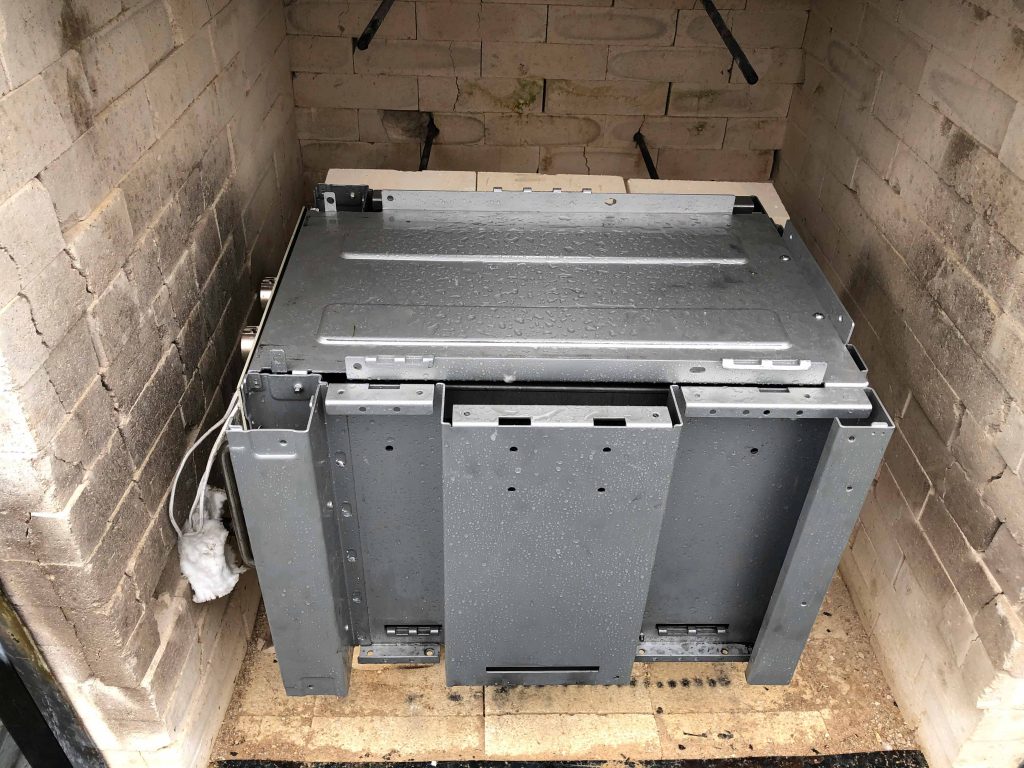
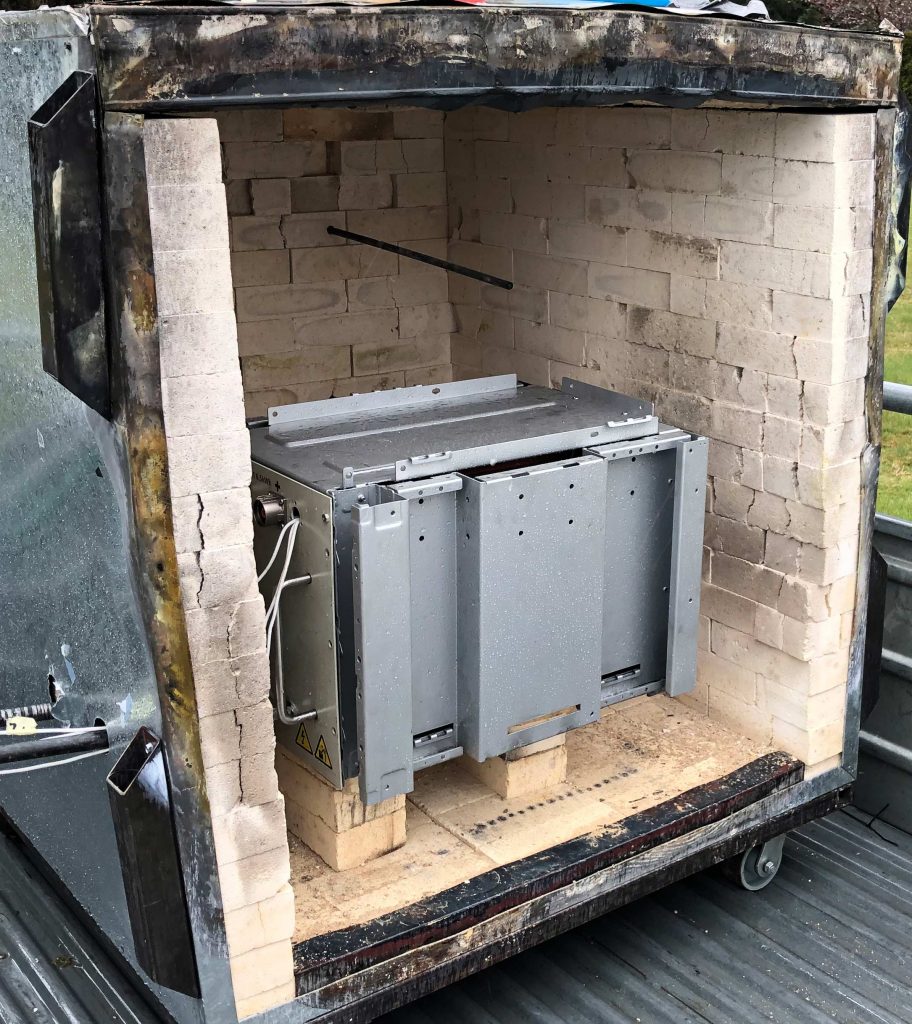
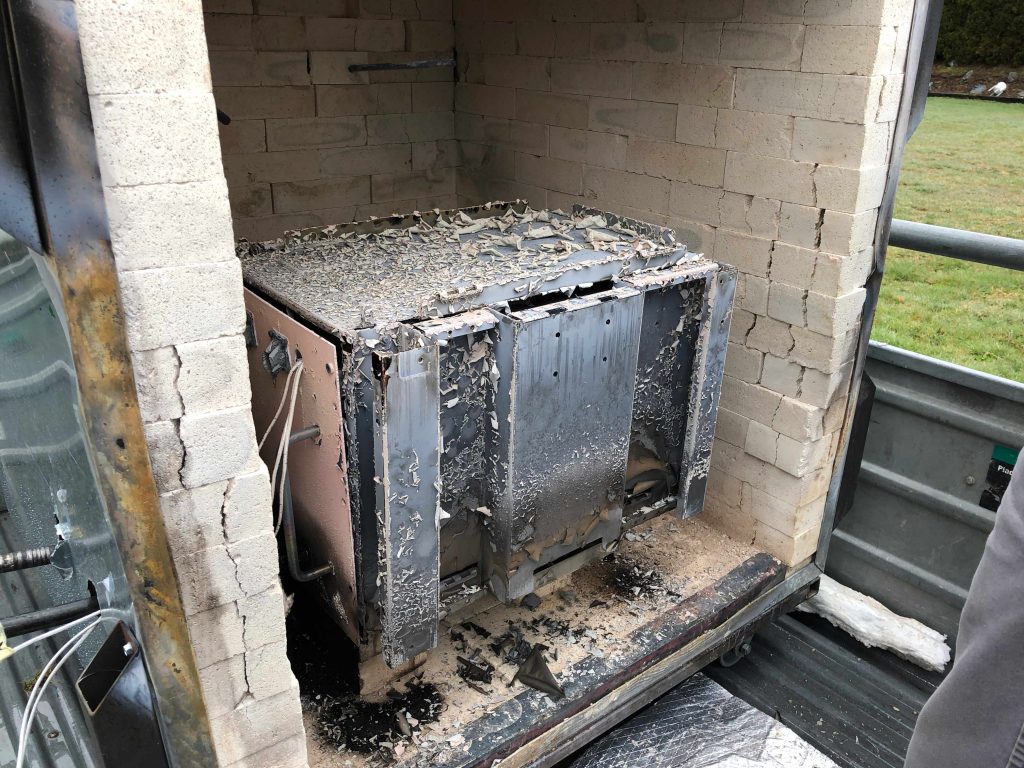
On March 24, 2020 – the engineering team at PlanB conducted an A60 fire ‘survivability’ test of the BBU battery module. The main purpose is to test the effectiveness of the BBU cooling system and to verify that the system can withstand a prescribed heat level for a defined period of 60 minutes and remain operable to cool the battery and prevent charged cells from entering thermal runaway.
Two separate tests were conducted:
Ensure the cooling system can withstand 215°C for 60 minutes without the cells exceeding 150°C. 215°C being the maximum A60 insulated bulkhead surface temperature. This test will demonstrate that the battery will remain safe from thermal runaway and safe to operate if a fire exists on the other side of a battery room bulkhead.
Determine how long the cooling system remains functional (with cell temperature below 150°C) while exposed to 950°C, with 950°C is the maximum temperature an A60 bulkhead has to withstand for 60 minutes. This test will demonstrate the survivability of the battery core (cells) and cooling system should the battery room experience a direct fire.
Standard SPBES Module and Racking, including all power electronics. Changes to standard battery for test are as follows:
Added fire-rated insulation to plumbing lines.
Added second gasket to cooling caps.
Summary of Results: A60 215°C Test
The battery module withstood the 60-minute heat with no visual degradation externally, no leakage from the cooling system and certainly no thermal event from the cells. Cell temperature during the test never exceeded 19.7°C. As the battery was in such good condition after Test 1, it was immediately used for the higher temperature Test 2 – the battery was not stripped down between tests.
Summary of Results: A60 950°C Test
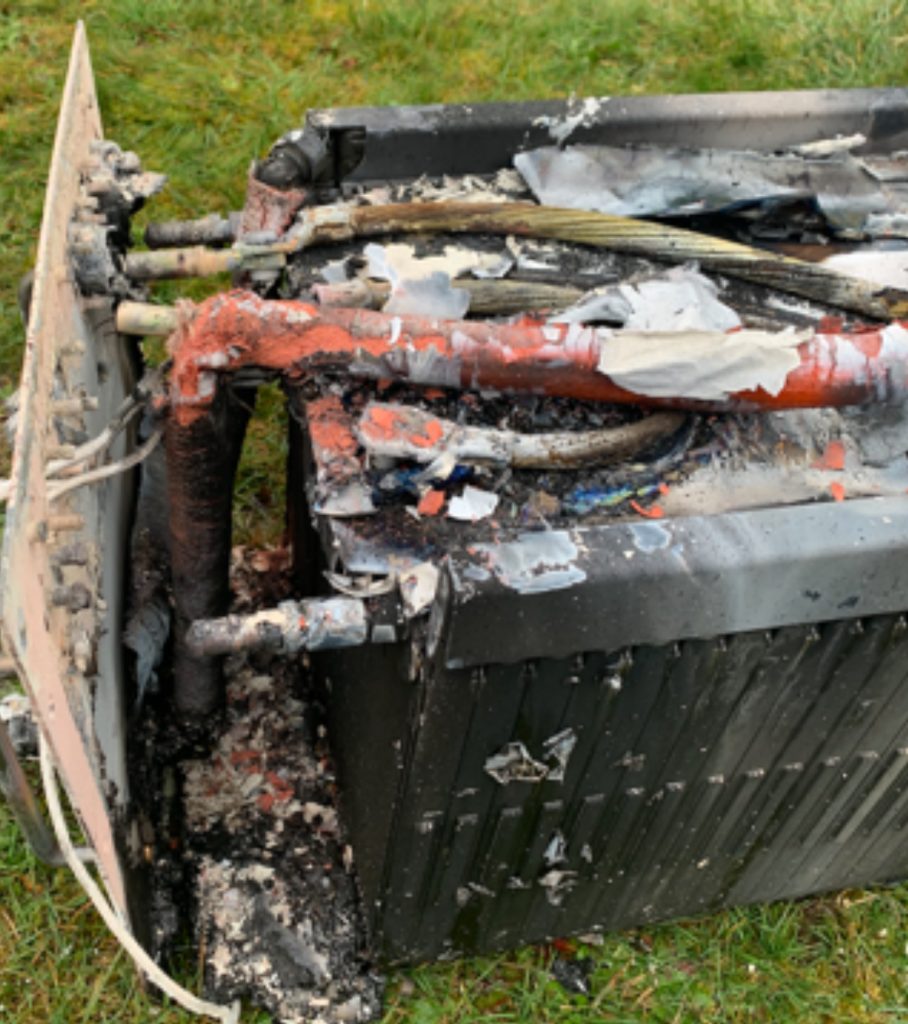
This test was also completed without interruption or issue. The heat rise was controlled to follow the IMO FTP Code heat formula, starting at 20°C and reaching an average temperature of 9500C. The plastic fittings and the power electronics within the battery were melted and destroyed by the heat, but the main battery core containing the cells and the cooling system was completely intact. During the test none of the lithium cells within the battery module went into thermal runaway – cell #1 temperature was recorded up to 154°C, with cell #24 reaching 396°C. However on examination of the cells, we have determined that this was due to melted plastics within the battery module reaching and affecting the thermocouple sensors. Cell #2 recorded a more realistic maximum temperature of 64°C after 60 minutes. Another test will be performed to validate the test results with more reliably located sensors, but our conclusion of physical examination is that the temperature of Cell #2 is likely to be a maximum of all of the cells. The cells would have not survived either a 154°C or a 396°C temperature without bloating and failure occurring, and none of the cells on inspection were significantly physically damaged.
Disassembly of Module
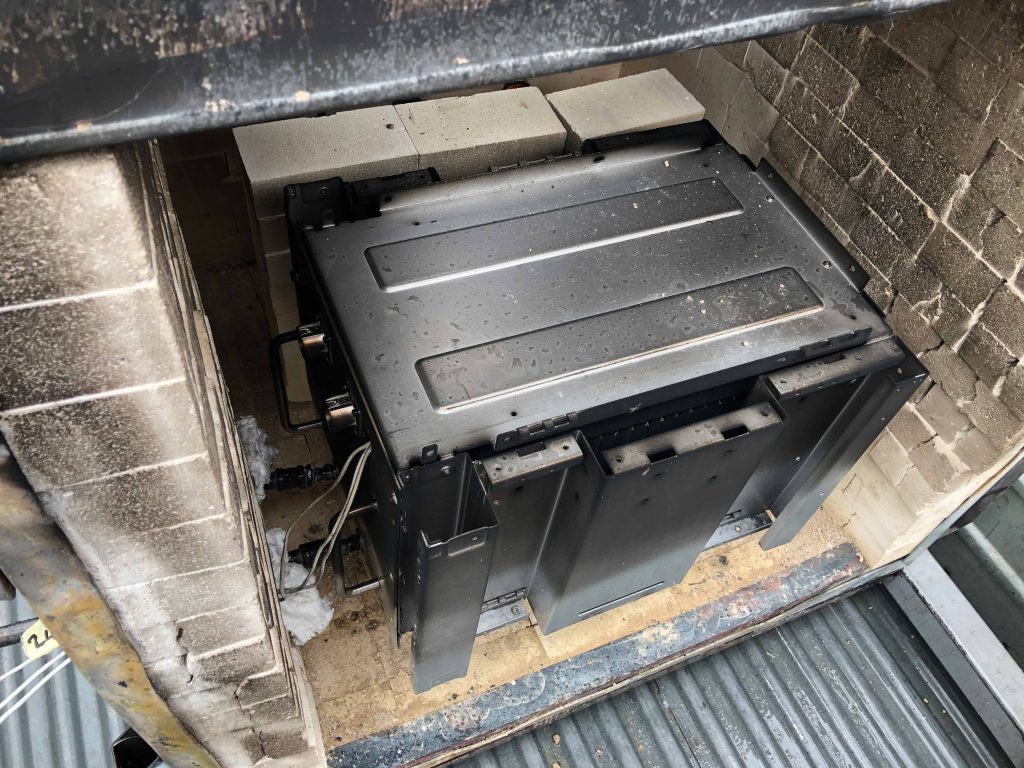
This picture was taken post both tests and shows the impact of the high temperature on the total surfaces, note the drooping power connectors on the front of the battery. Wires are the temperature sensors throughout.
Battery on exit of chamber, post 9500 C.
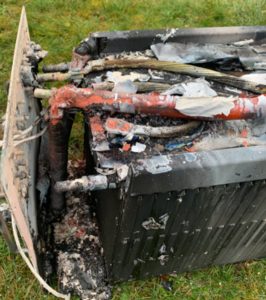
Total Destruction of the power electronics & PCB
This picture highlights the incredible effect of high temperature fires. If not insulated, everything is consumed. Cell carriers were totally intact, no damage at all.
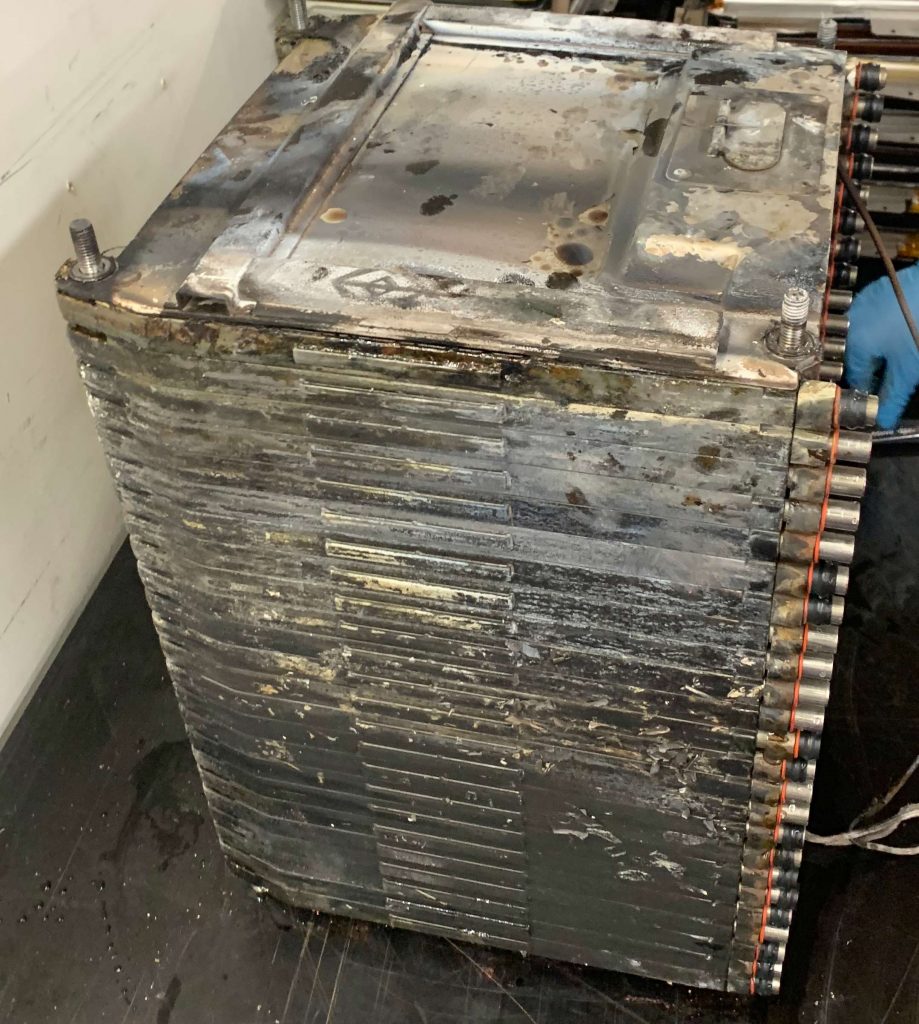
Battery Core
No damage occurred to either the gas seals or the water seals on the liquid cooling system. The vent survived without damage (high temperature seal intact also).
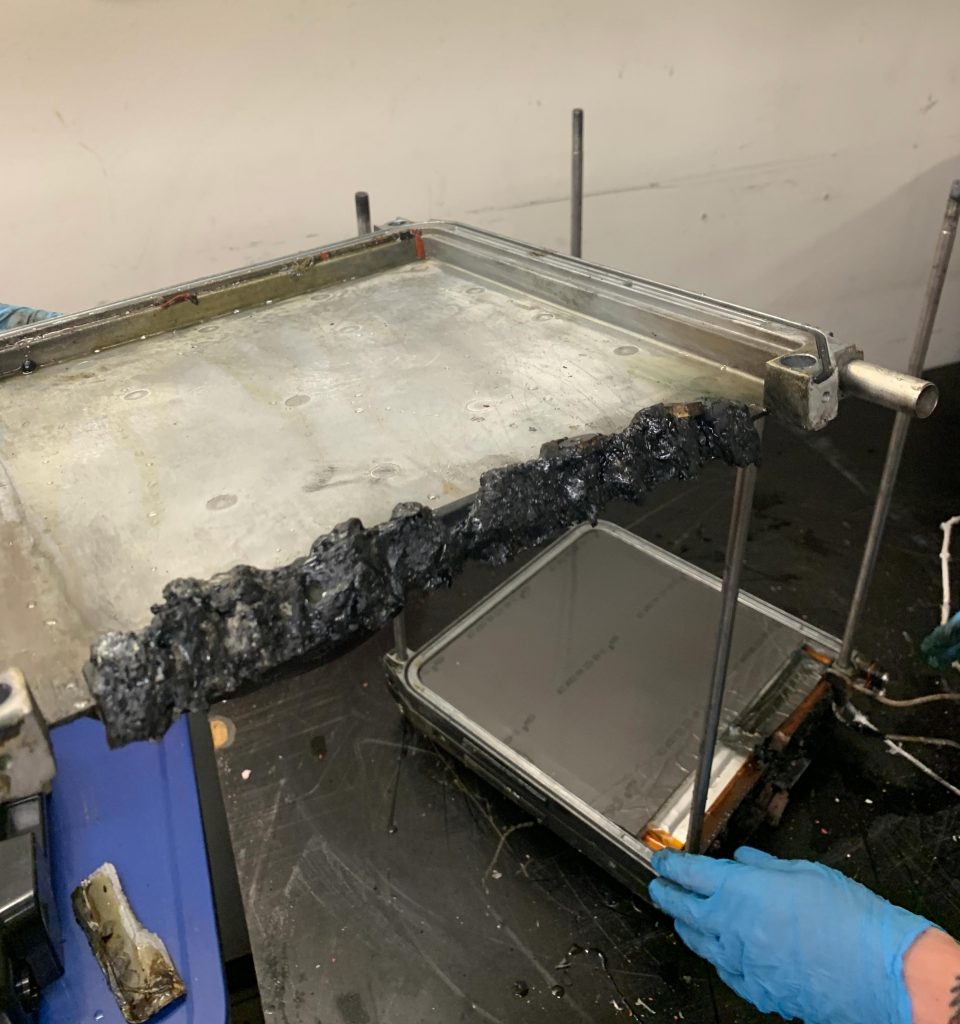
Cells
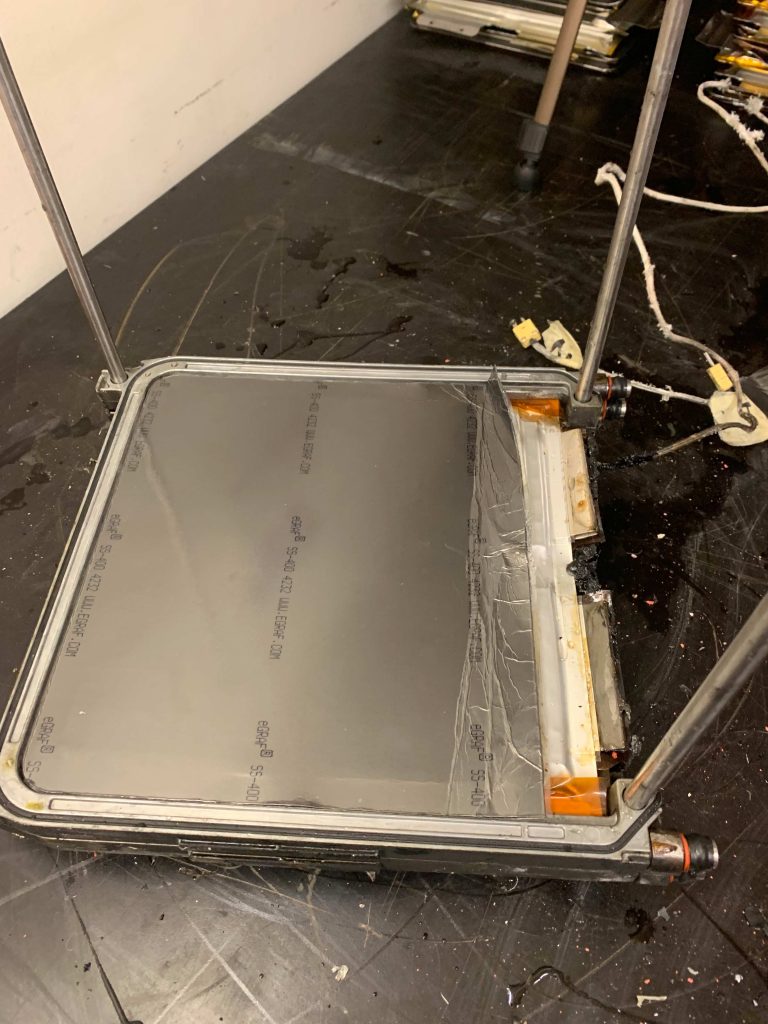
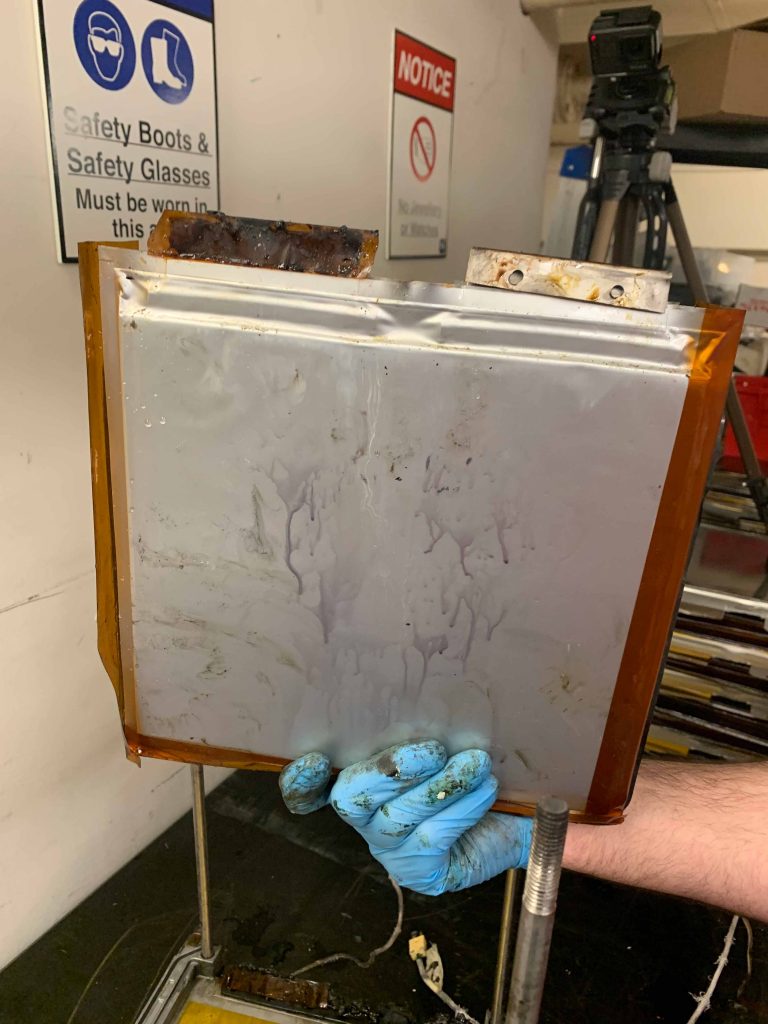
Incredible evidence of the damage of a high temperature fire, and the validation of the engineering in our thermal management system. Note the failed tab isolators, mostly melted on the side exposed to the heat, and the gasket that contains gas that survived fully intact on the outside ring with no damage at all. With the tab isolator removed, this cell carrier can be used again (it was already used in test 1 in December). Cells in are in great shape overall. Cell 2 was fully intact, graphite sheet in perfectly intact. Cell 2 was holding voltage 24 hours later.
Results
Our thermal management system is capable of protecting our lithium cells from contributing to a fire even directly in a A60 (up to 950°C) environment. The battery did not go into thermal runaway. When we completed the fire testing, it took about 20 minutes with no fire present to bring the cells down to about 25°C again, and after waiting about 24 hours, we were able to safely disassemble the batteries without any danger to workers, with no dangerous gases being emitted.
Next Steps:
We are very positive on what we have achieved, but all test results will always indicate a way to improve even further. Now that we are confident in our ability to manage thermal runaway at such extreme temperatures, we are going to take the next steps to reduce this risk even further:
Design a cooling system circuit that is completely capable of surviving an A60 fire to insure we have the cooling in operation and circulating during a fire. This will involve some discussion around power supply, safe locations and how to manage the plumbing routes, but we are confident planning and engineering can support a practical solution.
It is not yet tested as to what effect would be of the cooling circuit being disconnected during an A60 fire, something that needs to be accounted for to understand the relative importance of keeping the cooling in circulation. We have tested the effect of internal cell failure without cooling and are able to manage an internal cell failure or multiple (up to 24 cells) cells failing without causing thermal runaway, but not as of yet from the perspective of being in an A60 fire.
Improve the battery design. The following:
A heat barrier of ceramic insulation, rated at 1200°C or better would greatly improve the effect on cell 1 and cell 24 to prevent any heat impact from the front and back faces from being impacted by the heat.
Add high heat temperature insulation around the main power cables to prevent a dead short from contributing to a thermal runaway event. We did wrap a common point of crossover and it did manage to prevent dead short from occurring, but this is an area of high risk to further validate.
Consider a better way (better materials) to isolate the cell tab connectors from melting into the cell carrier space and prevent any possible failure of the cells at the cause of the melting of the cell tab connector materials.
Upcoming Testing:
Our next test for purposes of final validation of our batteries ability to prevent our lithium cells from contributing to a fire will be towards the end of April. We invite all Type Approval Agencies and Flag authorities to witness this next test. The testing will as always be witnessed by a third party for validation, and the final test results will be reported by a third party for full validation and integrity.
Published in Wind Energy Network magazine issue 57. Link can be found here
Kintech Energy
Limited
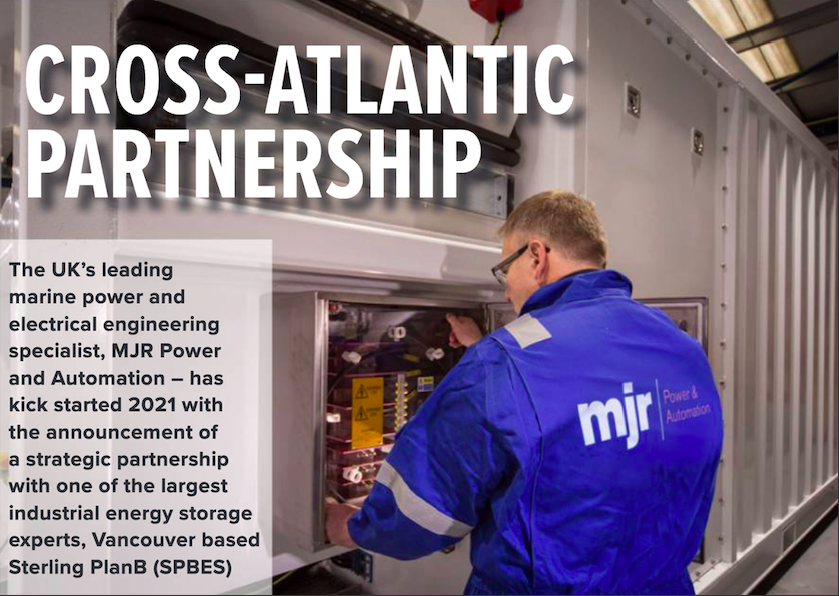
The partnership will
see MJR Power & Automation provide customers across the UK with energy
storage solutions and complete marine hybrid and electric propulsion systems.
These solutions will utilise SPBES’ innovative lithium-ion technology designed
and approved for use in both inland and seagoing vessels, ports, harbours and
in the offshore sector.
FURTHER BUSINESS
GROWTH
Speaking about the
partnership, Paul Cairns, Managing Director at MJR commented: “We are
delighted to have formed this strategic partnership with Sterling PlanB. There
is no doubt they are the world leader in marine energy storage systems and- by
adding their product to our portfolio– this enables MJR to further grow
our business in the clean technology space.
“Our expertise and
knowledge of marine power and propulsion system, combined with Sterling PlanB’s
world leading design and manufacture of energy storage solutions, we are
certain, brings an offering to the marketplace that is very much demanded by
the marine companies their drive to reduce fuel costs and develop sustainable
long-term solutions that meet global emission reduction targets.”
SUPPORTING MARINE
COMPANIES
With a great focus on
the UK’s maritime sector and growing offshore wind industry, the partnership
comes on the back of increasing pressure from the International Marine Organisation
(IMO) to support marine companies in achieving marine engine regulations and
reduce their Tier I, II and III emissions through the introduction of low
carbon technologies.
Commenting on the partnership
announcement, Paul Hughes, President of Sterling PlanB added: “We are very
pleased to have formed this sales and service partnership with MJR Power & Automation.
There is no better partner in the UK to distribute, integrate and service
Sterling PlanB energy storage solutions.
“Their broad multi-market reach coupled with their in-depth experience, exceptional reputation for customer service and a long list of satisfied clients, makes MJR an ideal partner to develop this most important market.”
LEADING SPECIALIST
Operating for over 20
years in the marine, offshore and energy sectors, MJR Power and Automation is a
leading specialist in marine power, electrical and automation engineering and
provides complete end to end complex projects from design, engineering and construction
to installation, commission, and worldwide service from its headquarters in
Teesside.
The business is approved
UK marine and offshore partners for Siemens, ABB and Danfoss with a number of
high profile turkey projects delivered for global leading customers. Its
impressive client portfolio includes the likes of, Subsea 7, Technip, Van Oord,
Stena Line, CalMac Ferries and A&P to name a few.
As demand for low emissions shipping increases, new partnership provides easier access to world class energy storage for Portugal.
Vancouver, Canada – March 10, 2021 – Industrial energy storage experts, Sterling PlanB (SPBES), and technical sales and installation company Marine & Land Electrical today announce a new partnership agreement. The partnership is aimed at expanding access to purpose-designed energy storage solutions to customers throughout Portugal.
The partnership comes when increasing scrutiny and regulations from IMO and EU green legislation means that many companies are rapidly adjusting their operations to reduce emissions. Many operators are now looking to energy storage solutions to help achieve this goal.
Under the new partnership, Marine & Land Electrical will provide customers in Portugal with Sterling PlanB energy storage solutions.
“We are delighted to have formed this sales and service partnership with Babis and his team,” said Brent Perry, CEO of Sterling PlanB. “Their experience, reputation, and long list of satisfied customers make Marine & Land an ideal partner to develop this important market.”
Babis Theodosiou, owner of Marine & Land said, “this partnership provides our customers access to clean technology with world-class energy storage products. We are proud to add Sterling PlanB to our list of products.”
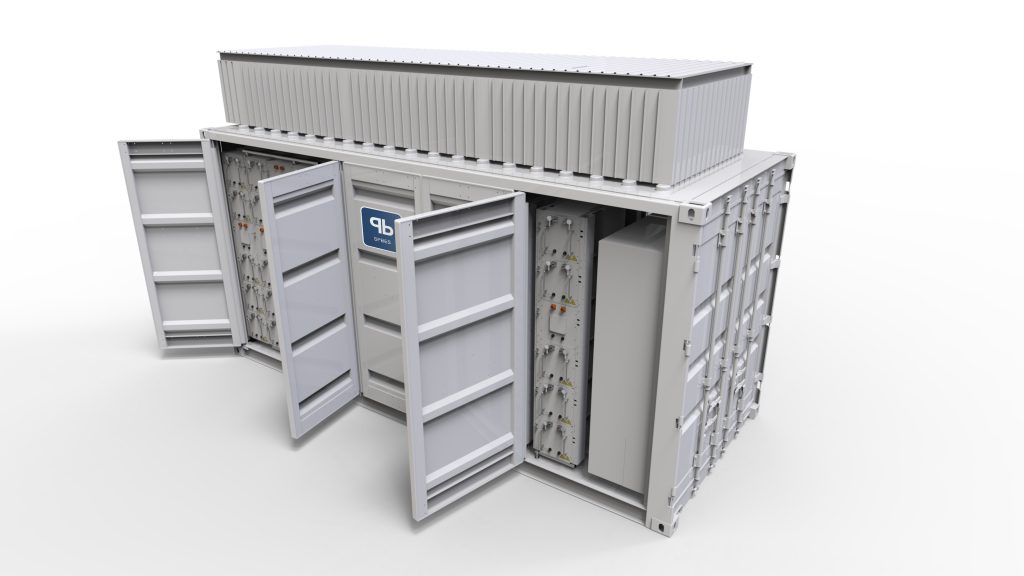
Sterling PlanB’s energy storage systems are engineered to the highest standards of performance and safety. They are designed specifically to integrate with any electrical infrastructure, delivering significant operational and efficiency benefits for vessels running on electric or hybrid power. The system is DNV GL Type Approved and is verified to fully prevent thermal runaway.
About Marine & Land
Marine & Land is an electrical engineering, supply and installation company based in Portugal that provides electrical services to maritime and land based customers.
Leading marine energy storage
company sets new safety benchmark, bolstering
the safe use of lithium batteries for commercial marine vessels
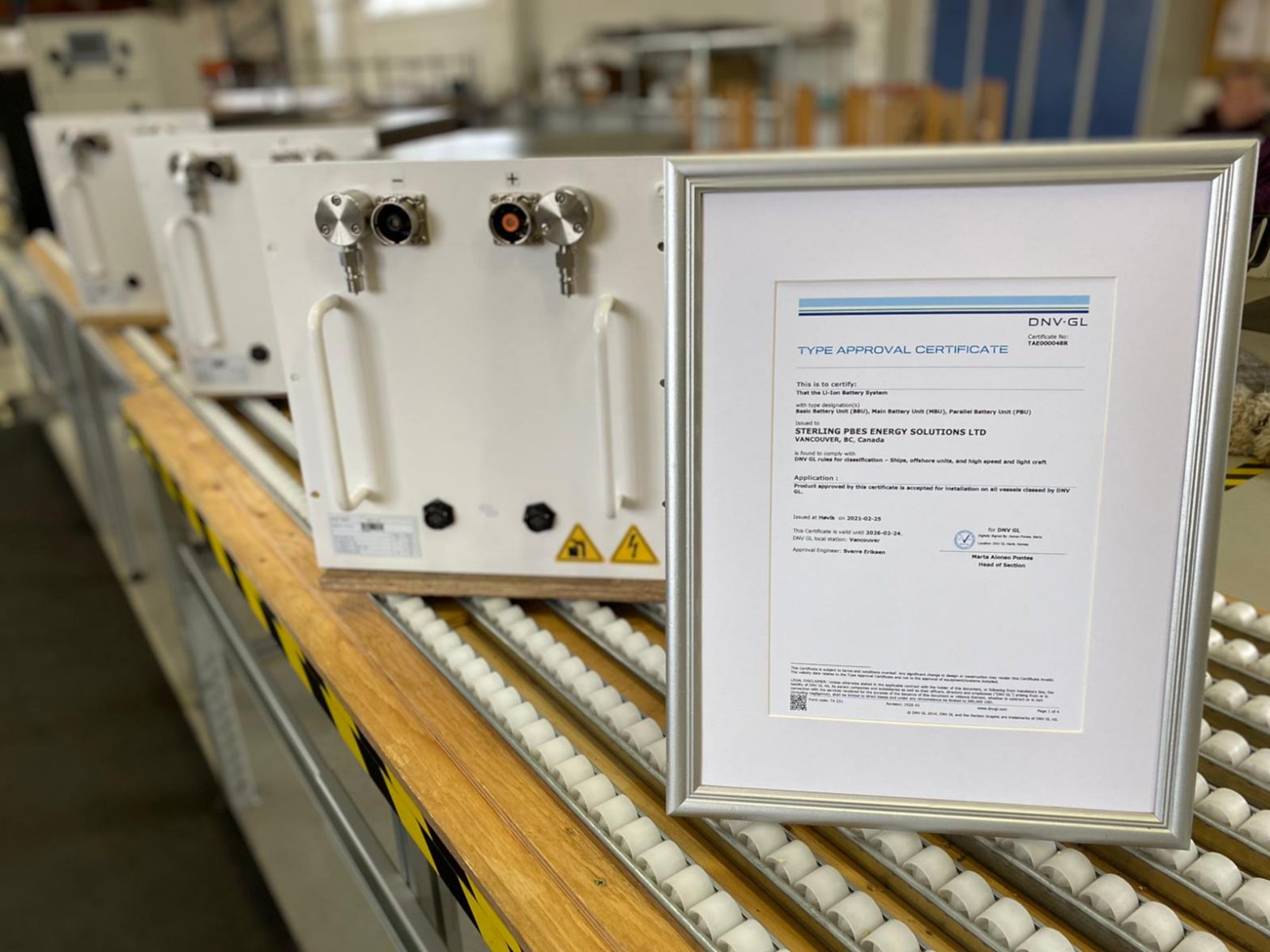
VANCOUVER, CANADA – 2 March 2021 – Marine and industrial energy storage expert, Sterling PlanB (SPBES) has announced that it is now fully certified under new 2020 class rules for commercial vessel batteries set out by classification society DNV GL.
As an early adopter of the certification, SPBES becomes one of the first energy storage solutions (ESS) providers to adhere to the new testing standard, which substantially mitigates the risk of the spread of fire by eliminating the propagation of thermal runaway within a battery module.
Securing the type
approval certification required extreme testing conditions. Across nine separate
tests – conducted for Sterling PlanB and observed by DNV GL – all standards were met.
Brent Perry, CEO,
Sterling PlanB, commented:
“After many months of
rigorous testing, we’re proud to have been certified under this new standard. While
these standards from DNV GL are
stringent, they are vital for the safety of commercial vessels using energy
storage. Our focus at Sterling PlanB has always been on building the safest and
most robust energy storage solution possible. We have never shied away from
the fact that there are risks to installing high capacity lithium batteries and
energy storage units on vessels, which must be treated with the level of
scrutiny and risk management as any other risks as sea.”
These are the first significant change to testing standards from DNV GL since 2015, and follow a number of high-profile incidents involving thermal runaway. Previous requirements from DNV concluded testing upon the first sign of initial cell failure but before combustion. Revised testing rules demonstrate the clear value of cell-level liquid cooling to prevent adjacent cells from contributing to a fire in a battery.
Sterling PlanB received certification
including thermal runaway testing to IEC 62619:2017 in conjunction with DNV GL certified testing
facility, LabTest Certification following testing of its 75ah, 85ah and 100ah
NMC cells on 14-18 December 2020.
As pressure to achieve IMO regulations increases, the partnership provides easy access to marine energy storage in the Netherlands, Belgium and Luxembourg.
Vancouver, Canada – February 23, 2021 – Industrial energy storage experts, Sterling PlanB (SPBES), and technical sales, installation and service company Gebhard Electro have announced a new partnership agreement today. The partnership is aimed at expanding access to purpose-designed energy storage solutions to marine customers in the Netherlands, Belgium and Luxembourg. Together, they increase access to hybrid and fully electric propulsion and power solutions throughout the region.
The partnership comes when increasing scrutiny and regulations tfrom IMO and EU green legislation means that many marine companies are rapidly adjusting their operations to reduce emissions. The recent push to establish greener inland waterway transportation, and a fast growing offshore wind industry means that many operators are looking to low carbon energy storage solutions.
Under the new partnership, Gebhard Electro will provide customers in the Netherlands with Sterling PlanB energy storage solutions for inland, offshore and short sea vessels. In so doing, together they support the drive not only for cost-saving operations, but a more sustainable long-term solution to meet emissions reduction targets.
“We are delighted to have formed this sales and service partnership with Gerard and his team at Gebhard Electro. There is no better partner in the Netherlands to distribute and service our equipment,” said Brent Perry, CEO of Sterling PlanB. “Their experience with delivery of marine power packages, exceptional reputation for customer service, and long list of satisfied customers makes Gebhard an ideal partner to develop this important market.”
Gerard Kraaij, Managing Director of Gebhard Electro said, “this partnership provides a unique avenue for Gebhard to grow its business by providing clean technology with world-class energy storage products and the exemplary service that we are already known for. We are proud to add the Sterling PlanB product line to our portfolio.”
Sterling PlanB’s energy storage systems are engineered to the highest standards of performance and safety. They are designed specifically to integrate with any electrical infrastructure, delivering significant operational and efficiency benefits for vessels running on electric or hybrid power. The system is the only lithium energy storage system third-party verified to fully prevent thermal runaway.
About Gebhard Electro
75 years ago, Gebhard Electro was established and started as an installation company. Now, Gebhard Electro has developed itself into an electrical system integrator in the maritime and industrial market. We have our own engineer department, own production, own installation team and our own service team. We offer complete electrical solutions and subsystems. With our broad knowledge and experience, we are able to give advice and have an obsessive focus on customer satisfaction. Visit www.gebhardelectro.com.
As
pressure to reduce emissions increases, MOU looks toward expert sustainability
solutions for Indian marine, defense and governmental sectors.
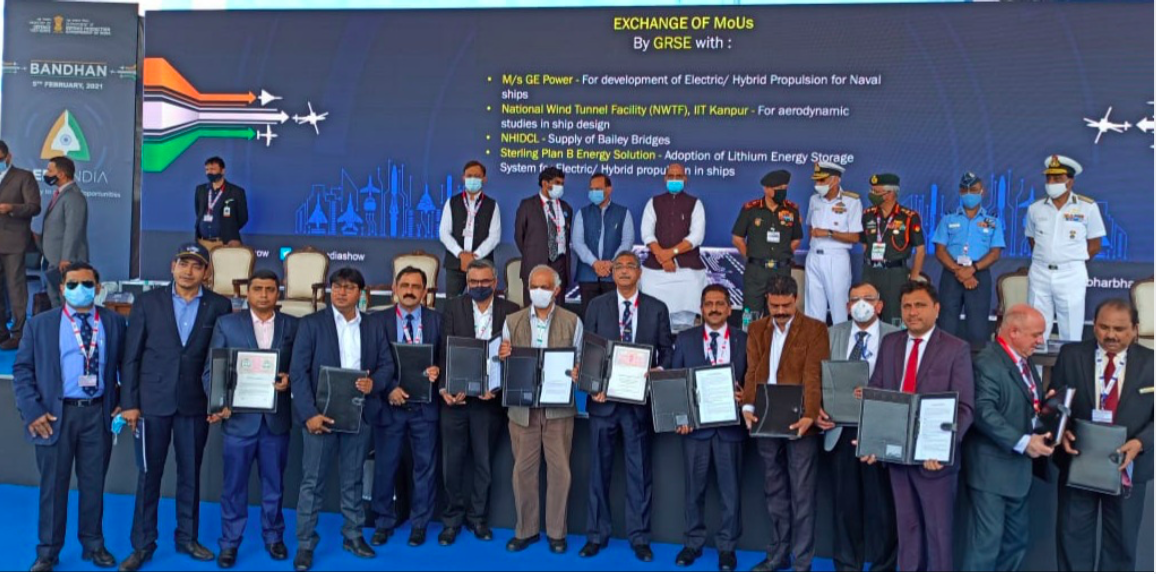
Vancouver, Canada – February 9, 2021 – Industrial energy storage experts, Sterling PlanB (SPBES), and Government of India company Garden Reach Shipbuilders and Engineers (GRSE) have announced a Memorandum of Understanding between the two companies. The MOU is intended to facilitate an increase in access to hybrid and fully electric propulsion and power solutions expertise throughout India.
The MOU comes at a
time when increasing pressure from international regulators to achieve emission
reduction targets means that all facets of industry must rapidly adjust their
operations. The growing economy and development of heavy industries in India, mean
that many government and non-government operators in the region are looking to
zero emissions and low carbon solutions.
Under the MOU, GRSE and SPBES have desired “to
explore avenues to collaborate to effectively leverage each other’s competence
and strengths in adopting ‘Electric/Hybrid Propulsion’ in ships by way of
undertaking new design development to offer state of the art environment
friendly ships to customers”.
“We are
very pleased to be selected by such a respected and important organization”
said Sterling PlanB CEO Brent Perry. “Their shipbuilding expertise in India is
second to none. We look forward to working with GRSE to provide their team with
strategic expertise in the practical application of energy storage solutions.”
“Ships transport about 80 percent of the world’s commodities and maritime transport is responsible for almost 2.5 percent of total greenhouse gas emissions. The challenge today is therefore to find effective solutions to move away from the use of fossil fuels. Energy storage devices are now finding effective utilization in ferries and inland water transport. As a leading shipbuilder in the country, GRSE looks forward to working with SPBES, which is a leader in providing niche energy storage technology to bring viable solutions for environmental-friendly transportation across the vast inland waterways of the country.” Chairman and Managing Director of GRSE, Rear Admiral V K Saxena IN.
The team at Sterling
PlanB is the most experienced on the planet. Their purpose designed energy
storage systems are engineered to the highest standards of performance, safety,
and efficiency. These systems are designed to integrate with existing
electrical infrastructure and deliver significant operational benefits for
vessels running on electric or hybrid power.
Published by the Naval Architect on January 2021. Link to the magazine can be found here.
By Brent Perry | Chief Executive Officer, Sterling PlanB
Brent Perry, CEO of battery solutions provider Sterling PlanB, on why marine decarbonisation requires sage and effective energy storage
Energy storage systems are vital for shipping to meet the decarbonisation timeframes already embedded in IMO target, as well as those to be included in the EU’s proposed Green Deal. Currently, the IMO requires a reduction in carbon intensity of at least 40% by 2030, and by 70% by 2050, compared to 2008 levels. Further, the IMO intends to reduce the sector’s total carbon emissions by 50% by 2050 compared to 2008.
This is just the beginning though, as this decarbonisation strategy will likely be revised to further increase ambition in coming years. Other regulators are set to introduce their own targets, but existing goals require immediate action by shipping companies. Not only to reduce the environmental impact of ships currently being designed and built, but also on those that are already in operation. Meeting these targets means implementing significant efficiency-boosting technologies today and preparing now for increased regulation in the future.
Weather on its own, in tandem with low or zero-carbon fuels, or in conjunction with other technologies, energy storage systems (ESS) will be key to hitting these targets. Recent rapid growth in ESS adoption saw 356 all-electric or hybrid vessels in operation or under construction last year, according to DNV GL, and the number has continued to grow during 2020. Where the majority of these are smaller craft or passenger vessels (vessels which can best take advantage of the ROI benefits of full electrification), projects such as the installation of a 600kWh ESS on the Maersk Cape Town show that the appetite and applicability for energy storage cuts across segments into larger ocean going vessels of all types.
The benefits of energy storage
Modern marine ESS’ are incredibly versatile. Available in many configurations and used for a variety of purposes, a modern battery, commonly built with lithium-ion cells, can help a vessel ensure compliance with emission regulations and can achieve operational cost savings for a wide variety of vessels.
For some ships, that means fully electric or hybrid propulsion. A recent DNV GL report for the European Maritime Safety Agency suggested that ferries could see fuel cost savings of up to 100% with a payback period of less than five years on ESS power, while they suggested that large cruise vessels could see cost savings of up to 5% from implementation of hybrid power systems. It also notes that the technology is particularly applicable to short sea shipping, dependent upon the route and operational criteria.
For larger vessels, peak shaving may be more appropriate. Current deep-sea vessels could see fuel savings of up to 14% through peak shaving, using an ESS to meet short spikes in energy demands to ensure that the vessels engines run at its optimum power settings for as long as possible. Simply reducing the need for additional generators to be brought online to meet intermittent loads can provide significant opex savings. In many of these applications, the energy from batteries is further used to power vital operational systems such as pumps, winches and carnes, or to offer hotel loads for crews that would otherwise be delivered via diesel generators.
Depending on vessel’s purpose, fuel saving are not the only issue. In some sectors, especially offshore, energy storage represents huge logistical and operational benefits by cutting risks. Risk reduction is achieved by providing instant spinning reserve, available in milliseconds from the batteries, which in turn delivers flexibility and value. In these configurations, and ESS can quickly provide immense amounts of energy, delivering back power to provide operators with vital redundancy and a time buffer if traditional equipment fails.
In other applications, an ESS could be solely used for other operational functions of vessel. This is how the system onboard the Maersk Cape Town operates and is particularly applicable to refrigerated cargo ships or those carrying refrigerated containers.
Refrigeration for these vessels requires vast amounts of variable power, changing based on the differential between the temperatures set by cooling systems and ambient temperatures. This has historically been delivered solely through onboard generators, which exposes owners to both high supplemental fuel costs and significant risk in the case of failure. Employing an ESS to provide peak shaving power and backup redundancy in this context has a huge benefit in actual cost reduction and risk mitigation.
These benefits are expected to become more pronounced as new zero-carbon fuels have lower energy densities than vessels are currently used to, providing smart support through energy storage will be more operationally important than ever. Biofuels, hydrogen or ammonia all benefit from additional power to augment heavy machinery starts or other intermittent loads. In the future, al commercial vessels will have a battery room and those which implement energy storage today will see the greatest cost savings and strategic advantage going forward.
However, as with any major maritime innovation, good design is critical for ensuring both safety and effectiveness. This design must encompass the whole of an ESS, as well as its surroundings and integration into other systems, from the start.
Holistic design unlocks the potential of energy storage
Good design is more than just designing powerful il-ion cells. Good design must cover the entirety of the space around those cells and the ESS itself, to ensure efficiency and safety.
Li-ion cells’ unique properties confer significant benefits over any alternative, but if poorly managed, they come with significant risk. Risk of thermal runaway is significant in that it is a rarely occurring event but can be catastrophic if it does happen. It starts when a damaged or faulty cell overheats, causing an exothermic reaction in adjacent cells, cascading through the entire battery. As these cells degrade, they emit highly flammable and toxic gasses. Without proper system in place, this chain reaction that could lead to fire or in the worst case, explosion.
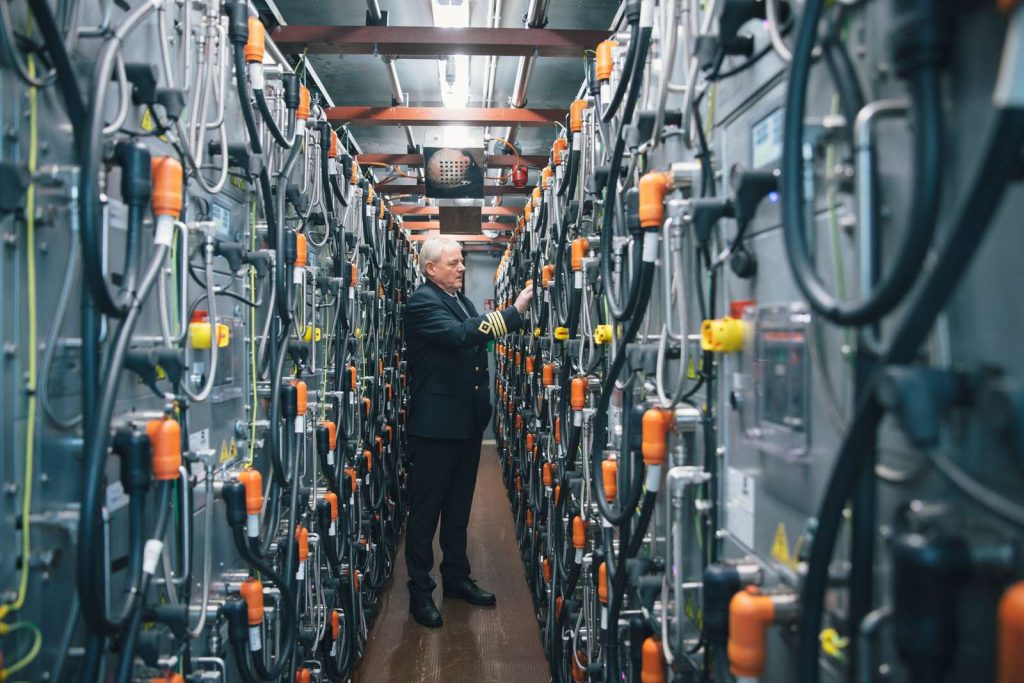
Simply put, all ESS require active cell cooling. Active cooling is most commonly derived from the circulation of a chilled liquid coolant through passages surrounding the cells. Liquid cooling, when integrated fully into the design of a system, ensures that the entirety of the cell is kept at a uniform temperature. Working in conjunction with thermal barriers between blocks of cells, the Sterling PlanB CellCool system has been designed to cool the very core of each module and every cell in the system. CellCool is so effective at removing thermal energy that it can cool the cells faster than they produce heat in a thermal runway type incident. This robust cooling has been third-party validated to prevent and even reverse thermal runaway after it has started. Until now, this effectiveness of cooling was unheard of in the lithium battery industry.
Uniform cooling also eliminates hotspots within cells that could cause accelerated ageing, or failure in the first place. Further, this level of constant, uninterrupted cooling provides increased performance capability and enables the ESS to run at an average continuous rate of 300% – allowing a 1MWh battery to provide 3MW of power for machine starts or any other intermittent loads.
Yet, even when taking these precautions, the risk of thermal runaway can be reduced, but never fully eliminated by any system. That is why explosion-proof, fully integrated venting systems are required to move toxic, flammable gasses from the battery to the outside of the vessel. Sterling PlanB’s patented and integrated ventilation system, E-Vent, vents the core of the battery, meaning the battery room is kept clear of fumes. This in turn reduces fire and explosion risk and allows safety or maintenance crews to re-enter the affected area sooner than if the area was filled with toxic and flammable gasses. Similarly, control electronics such as cooling pumps and alarms must be fully integrated into the vessel’s electrical infrastructure to make sure that all systems work together seamlessly – and cannot be unintentionally disabled by well-meaning crew.
Decarbonisation is already happening in the maritime industry and energy storage is key to enabling a painless transition for many vessel types. By future-proofing their fleets today using a product that provides rapid ROI, shipowners position themselves to have the advantage over their competition the coming years. However not all energy storage systems are equal, and it is critical that systems provided to the commercial marine industry are designed to deliver the quality, value, safety, and high level support that shipowners deserve and expect.
As pressure to achieve IMO regulations increases, and the UK set to
become a giant in the offshore sector, the partnership provides easier access
to more sustainable solutions for UK customers.
Vancouver, Canada – January 12, 2021 Industrial energy storage experts, Sterling PlanB (SPBES), and technical sales and service company MJR Power & Automation have announced a new partnership agreement today, aimed at expanding access to purpose-designed energy storage solutions to UK-based customers in marine markets. Together, they increase access to hybrid and fully electric propulsion and power solutions throughout the sector.
The
partnership comes when increasing pressure from IMO to achieve regulations
targets means that many marine companies are rapidly adjusting their operations
to reduce tier 1, 2 and 3 emissions. The recent push to establish greater, more
sustainable offshore sector services in the UK, and growing offshore wind means
that many offshore vessel operators are looking to low carbon energy storage
solutions
Under the new partnership, MJR Power
& Automation will provide customers in the UK with Sterling PlanB energy
storage solutions for offshore and short sea vessels, supporting the drive not
only for fuel- and cost-saving operations, but a more sustainable long-term
solution to meet emissions reduction targets.
“We are delighted to have formed this sales and
service partnership with Paul and his team at MJR Power & Automation. There is no better partner in the UK to
distribute, integrate and service Sterling PlanB energy storage solutions,”
said Paul Hughes, President of Sterling PlanB. “Their broad multi market reach
coupled with their in-depth experience
with delivery of marine power conversion
packages, an exceptional reputation for customer service and a long list of
satisfied customers makes MJR Power & Automation an ideal partner to
develop this most important market.”
Sterling
PlanB’s energy storage systems are engineered to the highest standards of
performance and safety, and are designed specifically to integrate with any
electrical infrastructure, delivering significant operational and efficiency
benefits for vessels running on electric or hybrid power. The system is the
only lithium energy storage system third-party verified to fully prevent
thermal runaway.
Paul
Cairns, Managing Director of MJR Power & Automation said, “this partnership
provides a unique avenue for MJR to grow its business in clean technology with
world-class energy storage products and the exemplary service that we are
already known for. We are proud to add the Sterling PlanB product line to our
portfolio.”
About MJR Power &
Automation
Operating for over 25
years in the marine, offshore & energy sectors, MJR Power and Automation is
a leading specialist in marine power, electrical and automation engineering and
provides complete end to end complex projects from design, engineering and
construction to installation, commission and worldwide service from its
headquarters in Teesside. The business has completed a number of recent high
profile, turnkey projects for global leading brands. Its impressive client
portfolio includes the likes of Stena, P&O, Subsea 7, Van Oord, TechnipFMC,
Boskalis, NOV & JDR to name but a few.
Published in Energetica India on December 2020. Link to the magazine can be found here.
By Ambarish Ghosh | Vice President Business Development, Sterling PlanB
Solar plus energy storage is perhaps the most viable option for standalone hamlets or villages where there is no grid connectivity, and the electricity is currently generated using diesel generator sets. With increased focus on climate change globally, there has been a shift towards renewable energy. India too is seeing a steady transition from fossil fuels towards renewable energy sources. With an ambitious target of achieving 40 percent of installed capacity based on renewable sources by 2030, energy storage appears to be the key to unlock the true potential of renewable energy and realize this target.
The elderly grandfather moves slowly through the darkness, wary of any obstacle that might be in his path. With confidence, he reaches out and flips a switch. Like magic, a warm light fills the room. In another house nearby, a table lamp illuminates the pages as a student studies with the help of her father in the evening after dinner and his long workday as a farmer. In the same village, a school that once closed at dusk is now open for more hours of the day, meeting increased demand for education in a growing population. Near the school, the only healthcare facility in the village used to close before dark. Now it is open in the evening, providing care to a few more sick patients each day. For the tired doctor and nurses inside, a fan cooling the air and a brightly lit room provide comfort and confidence to provide the care their patients deserve. In the town, electric streetlights now pro- vide safety and security to the residents; harmful kerosene lamps now just a relic of the past. In another home, a child runs in -excitedly narrating to his parents that which he just watched on a neighbour’s tv, informing and educating them about the world beyond their village. Close to town, a couple of looms or rural handicraft units now operate at peak capacity, 24 hours per day, providing good jobs to workers in the local village and ensuring they do not have to leave their families to find work. As evening darkens the village goes to sleep with a hope for next dawn. Thus, is the social impact of the electrification of rural India.
India is a land of villages. More than 600,000 villages are scattered around the rural areas of the country; each with a unique identity. These villages are where you get to know the true roots and character of this great country. Visiting a village may sound like a rustic affair but therein lies the true essence of India. Seventy percent it’s population – roughly one-tenth of humanity – live in this countryside. It is a testament to the people who live here that they continue to thrive, with limited facilities and rapid population growth. Indeed, India is thriving as a nation and on the international stage. This also makes rural India a focal point for issues of national and global concern. Economic and societal growth must be addressed. Improvements to society such as electrification, health- care, quality education and sanitation must be provided with minimal impact to the climate.
Over
the years, many of India’s resilient rural villages have been trying to remain
relevant and adapt to change without losing valued traditions and skills that
have survived down the ages. The Smart Village concept helps people access
basic life services and amenities like water and electricity and with advances
in technology, a gradual transition to sustainable and renewable energy
resources has begun to power the smart village concept. Solar panels on
rooftops are increasingly common in many villages.
Solar plus energy storage is perhaps the most viable option for standalone hamlets or villages where there is no grid connectivity, and the electricity is currently generated using diesel generator sets. With increased focus on climate change globally, there has been a shift towards renewable energy. India too is seeing a steady transition from fossil fuels towards renewable energy sources. With an ambitious target of achieving 40 percent of installed capacity based on renewable sources by 2030, energy storage appears to be the key to unlock the true potential of renewable energy and realize this target.
In
the example of a theoretical small village community on Sagardeep Island in the
Sunderbans district of West Bengal region of rural India, a population of 400-
450 people would require a photovoltaic system of ~26KW. This PV system would
then be fed into a 2MWh battery. This battery would be able to provide 125KW of
power for up to 16 hours before running out. In a more realistic scenario
(estimated), the loads from the community would more likely be only 20KW for
4hours in the evening, 4-6 KW during the night when residents are sleeping, and
then 4-6KW for a few hours in the morning before the sun rises and begins a new
daily charge cycle from the photovoltaic panels.
The world is moving away from fossil fuel power generation, and the people in rural areas are set to reap the biggest rewards. Today, the cost of installed solar is a fraction of the cost of even 5 years ago. Power electronics have got- ten smaller and more reliable while their cost has also fallen. Entire systems that were not feasible just a few years ago are now not only feasible, but also provide their owners with significant return on investment. The social implications are staggering. Rather than leave their homes and villages looking for opportunity (and often finding nothing but despair in the big cities), workers and students could opt to stay with their families, working during the day, children in school, and taking care of elderly parents afterward.
But the biggest advantage of having an energy storage in rural India is mechanization of rural economic activities leading to innovations and job creations. For example, in the states of Assam, Chhattisgarh, Jharkhand, and Odisha, solar-powered electric reeling machines have allowed women working in silk weaving cooperatives to increase their incomes and reduce drudgery. These machines, developed by a private company, use just 10 percent of the power of standard machines, yet they increase productivity and market competitiveness. Children become educated using a combination of in-class teachers for younger students, high school curriculum for teens, and maybe a post-secondary college education at the nearest town a few miles away. As they grow to adulthood, these same children are now able to apply their knowledge in their local community as educators, administrators, technical trade workers and community leaders. Who better to revitalize a community than those who know it from birth?
Ultimately, a hybrid solar/battery power plant provides the community a path forward to educate the young, provide meaningful employment for working-age people, to revitalize rural India and to keep families together.
Reliable,
clean electricity provides the social power to transform rural India and the
economic power to maintain this great country’s growth now and into the next
century.